

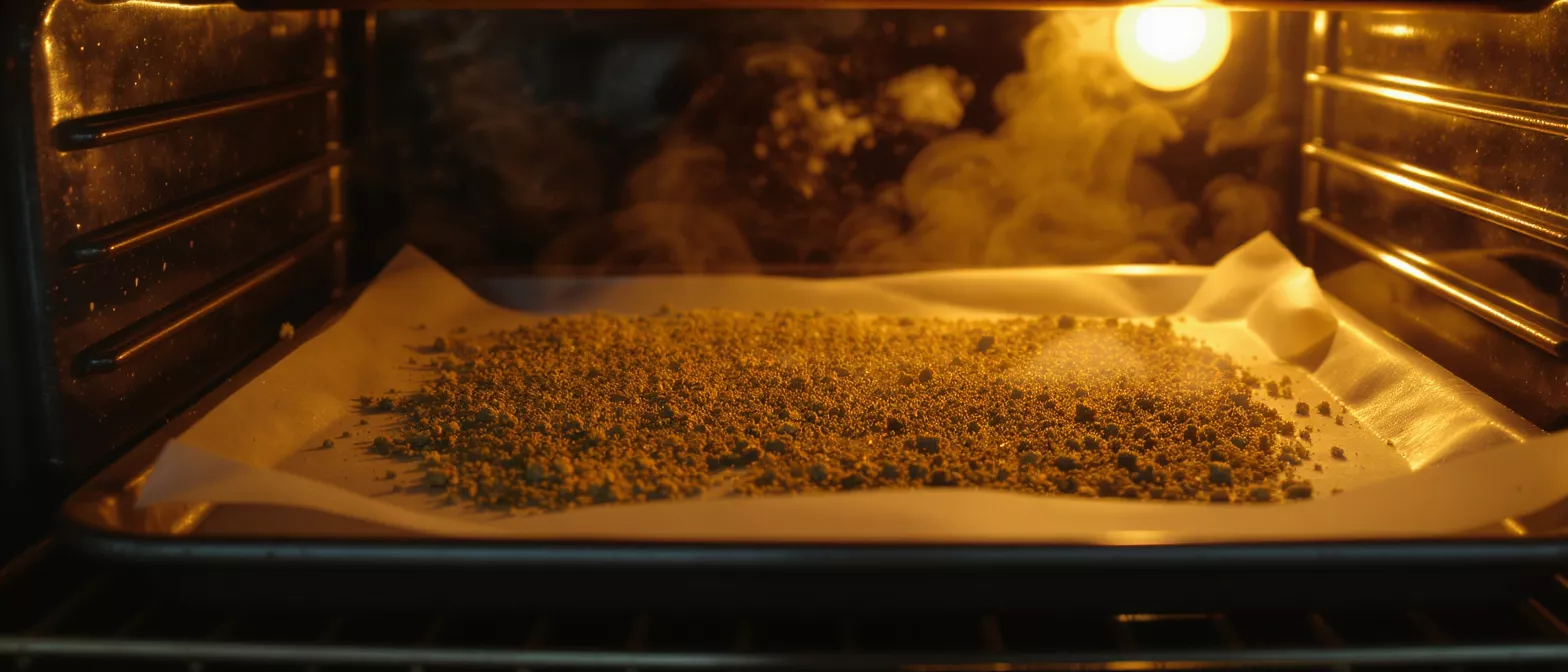
Decarboxylation
Learn how decarboxylation converts THCA to THC and activates CBD.
Decarboxylation is the heat-driven reaction that separates raw, inert cannabis flower from the potent, active material people actually want to consume. Inside fresh trichomes, cannabinoids exist almost entirely in acidic forms that produce little to no intoxication. Apply the right amount of warmth over the right span of time, and those acids shed a single chemical group to become the THC, CBD, and other compounds responsible for cannabis effects. Every joint, vaporizer hit, and tray of edibles depends on this conversion happening correctly.
This guide walks through the chemistry, the temperatures, the timing, and the hands-on kitchen techniques behind reliable activation. More importantly, it explains why each variable matters, so you can adjust your approach to favor potency, flavor, or consistency depending on what you are making.
What Is Decarboxylation in Cannabis
The plain-language definition: Decarboxylation is a chemical reaction that strips a carboxyl group (COOH) off a molecule, releasing it as carbon dioxide and a little water vapor. In cannabis, this reaction converts acidic precursors such as THCA and CBDA into their active counterparts, THC and CBD. The "A" in those abbreviations stands for "acid," and decarboxylation is precisely the step that removes it.
Raw cannabis is loaded with cannabinoid acids rather than the activated compounds most consumers expect. Eat a fresh bud straight off the plant and you would absorb almost no THC, because the plant manufactures THCA — a molecule that binds poorly to the body's CB1 receptors and therefore triggers no high. Heat is the catalyst that bridges that gap.
Where the term originates: The word is descriptive chemistry: "de" for removal and "carboxyl" for the COOH functional group being shed. The reaction sounds technical, yet humans have been triggering it for millennia simply by applying fire or warmth to the plant. Laboratory science only recently caught up to explain what generations of cannabis users had already experienced firsthand.
How Does Decarboxylation Work Chemically
At the molecular scale, decarboxylation is a thermal reaction driven by energy delivered over time. Each cannabinoid acid carries a carboxylic acid group bonded to its aromatic ring. When enough heat accumulates, the bond anchoring that group destabilizes, the carboxyl detaches, and it floats away as carbon dioxide gas. What remains behind is the neutral, fully activated cannabinoid.
The heat-versus-time relationship: Activation follows a curve, not an on-off switch. Lower temperatures sustained over longer periods achieve the same conversion as higher temperatures applied briefly — within limits. Push the heat too far and you start degrading the very compounds you created, converting THC into CBN and evaporating delicate aromatics in the process.
Light and oxygen also drive slow, ambient decarboxylation. A jar of cured flower parked in a sunny window will gradually convert a fraction of its THCA over weeks or months, which is exactly why cool, dark storage preserves potency. Deliberate heating simply accelerates a reaction that nature already performs on its own, just at a far slower pace.
Why Decarboxylation Matters for Edibles
When you smoke or vaporize cannabis, decarboxylation happens instantly as flame or hot air sweeps through the material. Edibles are a different story. Infusing raw, undecarbed flower into butter or oil produces a product saturated with THCA instead of THC — and the result is a batch that barely works, leaving people convinced their tolerance is enormous when the real culprit is incomplete chemistry.
The classic edible failure: Beginners routinely grind raw flower into melted butter, simmer it, strain it, and bake — skipping activation entirely. Because the infusion never sustained enough heat to fully convert the cannabinoids, the edibles underwhelm dramatically. Decarboxylating the flower first, before it ever touches the fat, is the single fix that separates frustrating experiments from dependable homemade edibles.
There is genuine nuance here. Some activation does occur during the infusion and baking stages, since both involve heat. But leaning on those steps alone yields inconsistent, weak results. A dedicated decarb step hands you a known, pre-activated starting material, which makes dosing predictable and the finished product far more potent and repeatable.
- 🔥 Activated cannabinoids: Pre-decarbed flower delivers full THC potency into the finished edible.
- ⚖️ Predictable dosing: Known activation lets you calculate milligrams per serving with confidence.
- 🧈 Cleaner infusions: Decarbing first lets the infusion focus on extraction, not conversion.
- ⏱️ Repeatable batches: Standardizing the decarb step makes every batch reproducible.
Decarboxylation Temperature and Time Chart
The most widely cited home decarboxylation method targets 240°F (115°C) for 30 to 45 minutes. This range threads the needle: hot enough to drive the reaction efficiently, yet gentle enough to preserve a respectable portion of the terpenes that give cannabis its flavor and feed the entourage effect. Different goals justify nudging these numbers up or down.
Choosing your target temperature: If terpene preservation is the priority, drop to roughly 220°F (104°C) and extend the time to 45 to 60 minutes. If you care only about maximum activation and speed, 250°F (121°C) for 25 to 30 minutes does the job, though you forfeit more aroma. Climbing much past 300°F risks vaporizing and outright destroying the cannabinoids you worked to create.
- 🌡️ 220°F / 104°C: 45–60 minutes — gentle, best terpene retention.
- 🌿 240°F / 115°C: 30–45 minutes — the balanced standard most guides recommend.
- ⚡ 250°F / 121°C: 25–30 minutes — faster, with slightly more terpene loss.
- 🚫 300°F+ / 149°C+: Avoid — cannabinoids begin degrading and burning off.
Keep in mind that oven thermostats are notoriously inaccurate, frequently swinging 20 to 25 degrees from the displayed setting. An inexpensive oven thermometer is the single best investment for consistent decarboxylation, eliminating the largest source of variability in the entire process before it can sabotage a batch.
How to Decarboxylate Cannabis at Home
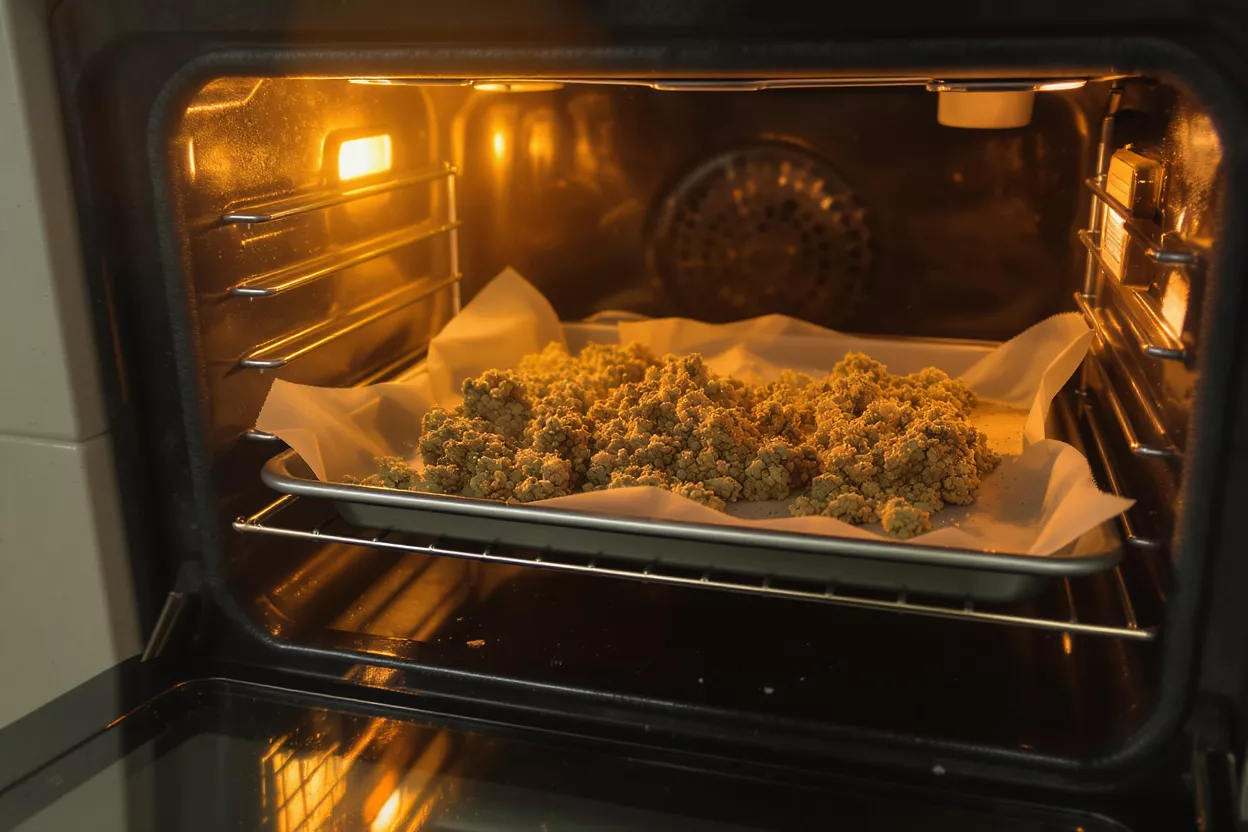
The classic oven method asks for almost nothing: cannabis flower, a baking sheet, parchment paper, and an oven. Break the flower into small, even pieces by hand rather than grinding it to powder, since fine dust scorches easily. Spread the pieces in a single layer on parchment-lined metal, slide the tray into a preheated oven, and let the heat do the work.
Step-by-step oven method: Preheat to 240°F and confirm the real temperature with a thermometer. Spread your broken-up flower across the parchment, cover loosely with a second sheet if you want to contain aroma, and bake for 30 to 40 minutes. The flower will shift from bright green to a toasted, golden-brown — your visual cue that the reaction has progressed.
- 🔧 Prep: Break flower into pea-sized pieces; skip the fine grinding.
- 📄 Layer: Spread evenly on a parchment-lined baking sheet, single layer.
- 🌡️ Heat: Bake at 240°F for 30–40 minutes, stirring once halfway through.
- 👀 Check: Look for an even golden-brown color and a dry, crumbly texture.
- ❄️ Cool: Let it rest before grinding it for infusion.
Mason jar and sous-vide methods offer more aroma control and tighter precision. The sealed-jar approach traps escaping terpenes so they can recondense onto the flower, while sous-vide submerges sealed cannabis in a precisely held water bath that eliminates temperature swings entirely. Both take longer, but they reward patience with cleaner flavor and noticeably tighter consistency.
THCA to THC Decarboxylation Explained
The conversion of THCA to THC is the headline reaction for anyone chasing psychoactive effects. THCA is larger than THC by exactly the mass of one carbon dioxide molecule plus the associated water loss. Once the carboxyl group departs, the remaining THC slots neatly into CB1 receptors in the brain — the binding event responsible for the cannabis high.
Why raw THCA does not get you high: THCA's bulky carboxyl group blocks it from crossing the blood-brain barrier and engaging cannabinoid receptors the way THC does. This is why raw cannabis juice and fresh-leaf consumption are pursued for potential wellness benefits without intoxication — the THCA stays intact. Activation is a one-way door, too: once decarbed, there is no converting THC back into THCA.
Interestingly, THCA is drawing attention for its own properties, independent of its role as a THC precursor. Research curiosity around non-intoxicating acidic cannabinoids keeps growing. Still, for the traditional edible, tincture, or smoking experience, full conversion to THC remains the practical objective for most consumers.
Decarboxylation of CBD and Minor Cannabinoids
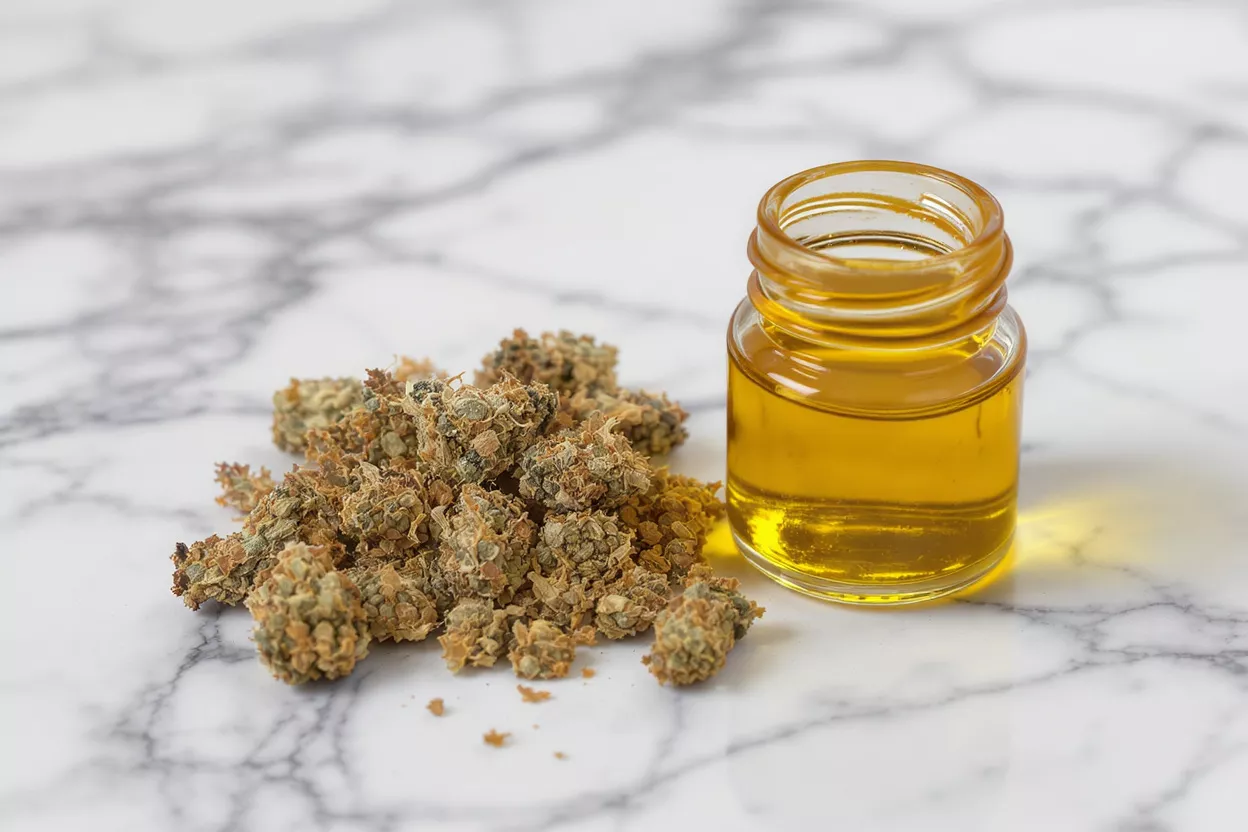
Decarboxylation is in no way exclusive to THC. CBDA converts to CBD through the identical loss of a carboxyl group, and the same logic applies to CBGA becoming CBG along with other minor cannabinoids. The temperature and time requirements run broadly similar, which is convenient — a single decarb session activates the full cannabinoid profile of a high-CBD or balanced hemp strain.
Subtle differences between cannabinoids: CBDA tends to decarboxylate at marginally higher temperatures or over slightly longer durations than THCA, though the standard 240°F window handles both well enough. For CBD-dominant material headed toward wellness products, many makers lean to the lower, slower end of the range to protect the broader spectrum of compounds.
Because most flower carries a blend of cannabinoids, a properly executed decarb activates everything in one pass. The acidic forms — THCA, CBDA, CBGA — all shed their carboxyl groups under sustained heat, leaving an activated, full-spectrum base ready for infusion or further processing into your preferred format.
Common Decarboxylation Mistakes to Avoid
The most damaging mistake is overheating. Anxious to "make sure it worked," people crank the oven to 350°F and end up vaporizing a meaningful share of their cannabinoids alongside nearly all their terpenes. More heat is not better — it is the fastest route to a weaker end product and a kitchen full of the very compounds you wanted to keep locked in the flower.
Underheating and impatience: The opposite error is pulling the tray too early or running the oven too cool, leaving much of the THCA unconverted. That produces feeble edibles and the false impression that the flower itself was low quality. Trusting a verified temperature and committing to the full recommended time guards against both extremes at once.
- 🔥 Too hot: Above 300°F degrades THC into CBN and destroys terpenes.
- 🧊 Too cool: Insufficient heat leaves THCA unconverted and edibles weak.
- 📏 No thermometer: Trusting the oven dial alone introduces enormous error.
- 🌀 Over-grinding: Powder-fine flower scorches and heats unevenly.
Uneven heating is another quiet saboteur. Without a single stir halfway through, the flower nearest the heating element can scorch while pieces resting on top stay underdone. One gentle stir redistributes the heat and yields a far more uniform activation across the entire batch.
How Decarboxylation Affects Terpenes
Terpenes are the volatile aromatic compounds behind cannabis flavor and much of its strain-to-strain personality, and they are considerably more heat-sensitive than cannabinoids. Many terpenes begin evaporating at temperatures well below those used for decarboxylation, which means every session involves a genuine trade-off between activation and aroma preservation.
Balancing potency against flavor: This is exactly why lower-temperature, longer-duration methods appeal to flavor-focused makers. Sealed-jar and sous-vide techniques shine here, trapping volatilized terpenes so they recondense back into the material instead of escaping into the air. The payoff is more of the strain's signature nose and a fuller synergistic entourage effect in the finished product.
When aroma simply is not a priority — say, when making a neutral-tasting oil for capsules — terpene loss becomes an acceptable cost of efficient activation. Understanding this trade-off lets you tune your method to the goal in front of you rather than chasing one mythical "perfect" temperature that serves every purpose equally well.
Is Decarboxylation Always Necessary
Whether you need a deliberate decarboxylation step hinges entirely on how you plan to consume cannabis. For smoking and vaporizing, no separate step is required — combustion or hot-air vaporization activates cannabinoids in real time as you inhale. The reaction is so fast and complete that the question rarely even comes up for traditional consumption.
When a dedicated decarb step is essential: Edibles, tinctures, capsules, and topicals intended for psychoactive or full cannabinoid effect all benefit enormously from deliberate decarboxylation before infusion. Skipping it is the leading cause of disappointing homemade products. If you want predictable potency in anything you eat or absorb, the decarb step is genuinely non-negotiable.
The exception is raw cannabis consumption pursued specifically for the acidic cannabinoids themselves. Juicing fresh leaves and flower, or dropping raw cannabis into a smoothie, intentionally preserves THCA and CBDA for their non-intoxicating properties. In that narrow case, decarboxylation would defeat the entire purpose — proof that the "necessity" of activation always depends on your destination.
Decarboxylation is the quiet chemistry that turns a plant into a precise, usable ingredient. Master the relationship between temperature and time, respect the heat-sensitivity of terpenes, verify your oven with a thermometer, and you transform unpredictable experiments into reliable results. Whether your goal is potent edibles, flavorful infusions, or simply a deeper grasp of what happens every time you spark a bowl, this single reaction sits at the heart of nearly everything cannabis can become.
Comments