


Diffusion
Learn how diffusion breaks smoke into fine bubbles for cooler, smoother hits.
What Is Diffusion in Cannabis Water Pipes
Diffusion is the process of breaking a single stream of smoke into many smaller streams as it passes through water inside a bong or water pipe. Rather than letting a thick column of hot smoke rush through the liquid in one undisturbed slug, a diffuser forces that smoke through slits, holes, or other small openings. The result is a cloud of tiny bubbles instead of a few large ones, and that simple change in geometry transforms how the smoke feels when it reaches your lungs.
The concept borrows directly from physics. In chemistry, diffusion describes how particles spread out from areas of high concentration to areas of low concentration. In a water pipe, the principle is applied mechanically: by fragmenting the smoke, you maximize the contact between smoke and water, which is exactly what cools and filters the draw. The more thoroughly the smoke is dispersed, the more effective that water bath becomes.
Why glassblowers obsess over diffusion: The difference between a harsh, scratchy hit and a velvety one often comes down to how well a piece diffuses. This is why so much of modern percolator design centers on creating more openings, finer slits, and clever pathways for smoke to travel before it ever leaves the water.
How Smoke Diffusion Works in a Bong
When you light your bowl and inhale, smoke is pulled down through the downstem and into the water. In a plain, open-ended tube, that smoke escapes as one big bubble that races to the surface with minimal contact time. A diffuser changes the journey entirely by introducing resistance and division at the point where smoke meets water.
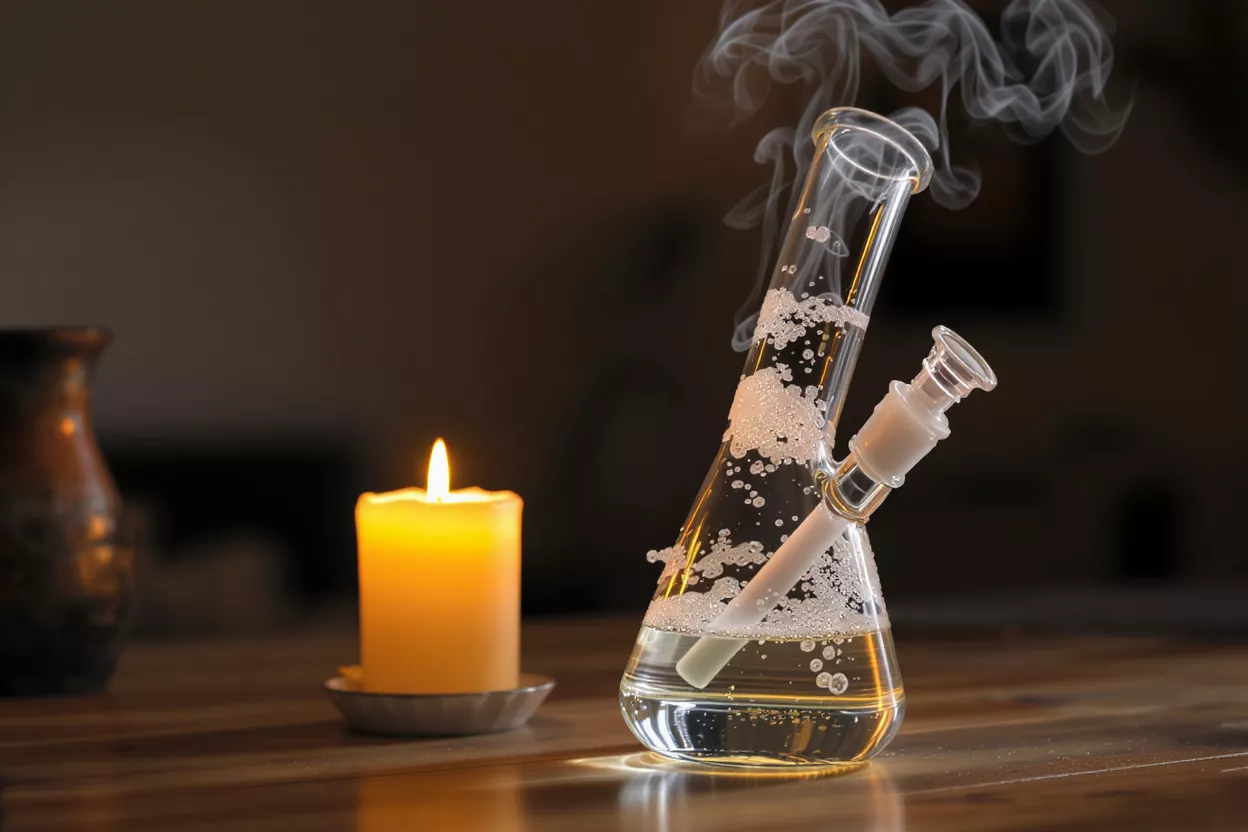
The slits or holes in a diffuser act like a sieve. As smoke is forced through dozens of tiny openings, the single column splits into a fine spray of bubbles. Each of those bubbles carries far more surface area relative to its volume than one large bubble would, and surface area is where the magic happens. More boundary between smoke and water means more heat is shed and more soluble particulates are captured before the smoke ever reaches your mouthpiece.
The bubble-size principle: Smaller bubbles equal better performance. A single one-inch bubble has a fraction of the surface area of the hundreds of pinhead-sized bubbles that replace it after diffusion. This is the entire reason a well-engineered piece can feel dramatically smoother than a basic tube, even with the same amount of water.
Why Surface Area Matters for Filtration
Surface area is the unsung hero of every good water pipe. When smoke and water meet, the exchange of heat and the trapping of water-soluble compounds happen only at the boundary between the two. A large bubble has very little boundary relative to the smoke trapped inside it, so most of that smoke never actually touches water. Diffusion fixes this inefficiency by multiplying boundaries.
Think of it like trying to cool a hot drink. A single ice cube melts slowly, but the same volume of ice crushed into shards cools the liquid almost instantly because there is far more surface in contact. Diffusion does the same thing for smoke, shedding heat across countless tiny interfaces in the split second the bubbles take to rise.
- 🫧 More bubbles, more contact: Splitting one bubble into hundreds multiplies the smoke-to-water interface dramatically.
- ❄️ Faster cooling: Heat dissipates across every bubble surface, lowering the temperature of the draw.
- 💧 Better particulate capture: Water-soluble compounds and ash particles get caught more effectively at the increased boundary.
- 🌬️ Smoother inhale: Cooler, cleaner smoke is gentler on the throat and lungs.
This is also why adding more water than the diffuser is designed for rarely helps. Beyond the point where the diffuser is fully submerged, extra water just creates drag without adding meaningful surface area. The diffuser, not the volume of water, is doing the real work.
Types of Diffusion Percolators
Percolators are the dedicated diffusion chambers built into many water pipes, and they come in a remarkable variety of shapes. Each style represents a different approach to the same goal: split the smoke into as many bubbles as possible without choking the airflow so much that the piece becomes hard to pull. The best designs strike a balance between aggressive diffusion and comfortable draw resistance.
The most common percolator styles: Different geometries suit different priorities, from raw bubble count to ease of cleaning. Here is how the popular families compare.
- 🌳 Tree perc: Multiple vertical arms, each slitted at the bottom, fan out like branches to create many diffusion points.
- 🍯 Honeycomb perc: A flat disc drilled with dozens of small holes produces an extremely fine, even stream of bubbles.
- 🌀 Showerhead perc: A vertical tube flares into a slitted head that pushes smoke outward in all directions.
- ⚙️ Turbine perc: Angled slots spin the water into a vortex, adding a visual swirl on top of solid diffusion.
- 🔵 Matrix perc: A gridded cylinder with horizontal and vertical slits offers heavy diffusion in a compact form.
Stacking percolators is also common in higher-end pieces, where smoke passes through two or more chambers in sequence. Each stage refines the bubbles further, though every added chamber increases draw resistance, so designers weigh smoothness against the effort required to clear the pipe.

Diffuser Downstems Explained
Before percolators became standard, the simplest form of diffusion lived in the downstem itself. A diffuser downstem is a tube with a series of slits or holes cut into its submerged end, replacing the old open-ended design. It is the most accessible upgrade for a basic water pipe and often the first piece of glass smokers swap out to improve their experience.
The slit count and slit width on a diffuser downstem determine how finely it breaks up the smoke. A downstem with more, narrower slits produces finer bubbles and smoother hits, while fewer, wider slits offer less resistance but coarser diffusion. Many are removable, which makes them easy to clean and simple to replace if they chip.
Matching the downstem to your joint: Diffuser downstems come in standard ground-glass sizes, and getting the right length matters as much as the joint fit. A stem that is too long sits too deep and forces you to overfill with water; one that is too short barely submerges the slits, defeating the diffusion entirely. Measuring from the joint to the desired water line is the key to a proper fit.
Diffusion Benefits for a Smoother Hit
The headline benefit of diffusion is comfort. By cooling the smoke and capturing harsh particulates, a well-diffused draw reduces the coughing and throat irritation that come with dry, hot smoke. For anyone sensitive to harshness, the difference between a diffused and an undiffused hit is immediately noticeable from the first inhale.
Beyond raw smoothness, diffusion lets you take larger, more complete pulls without the punishing bite. Because the smoke arrives cooler and cleaner, your throat tolerates more in a single breath, which many users find makes their sessions more controlled and enjoyable rather than a test of endurance.
- 🌬️ Cooler temperature: Diffused smoke loses significant heat before reaching your lungs.
- 😌 Less throat irritation: Finer bubbles strip away more of the harsh, scratchy edge.
- 💨 Bigger comfortable pulls: Smoother smoke means larger draws without the cough.
- ✨ Cleaner flavor: Reduced harshness lets the natural taste of the flower come through.
It is worth noting that diffusion is about quality of experience, not a health pass. Filtering smoke through water removes some particulates, but it does not make smoking safe. The benefit is a more pleasant, controllable session, and that should be the honest framing whenever diffusion is discussed.
Diffusion vs Filtration: What's the Difference
The terms diffusion and filtration get used interchangeably, but they describe two related stages of the same process. Diffusion is the mechanical act of breaking smoke into smaller bubbles. Filtration is the result that follows: the capture of water-soluble compounds and particulates as those bubbles travel through the water. You cannot have effective filtration without good diffusion first.
In practice, the better a piece diffuses, the more it filters, because filtration depends entirely on contact between smoke and water. A piece that produces large, fast bubbles offers minimal filtration no matter how much water it holds, while a fine-bubble percolator filters far more thoroughly. Diffusion is the cause; filtration is the effect.
What water actually removes: Water primarily traps water-soluble particulates and some of the ash and tar carried in the smoke. It does not capture the active cannabinoids in any meaningful amount, since compounds like THC are not water-soluble. This is a common point of confusion, and understanding it helps set realistic expectations for what a water pipe does and does not do.
Does Diffusion Affect Potency
A frequent worry among new water pipe users is whether all that filtering strips away the good stuff. The reassuring answer is that diffusion has very little effect on potency. The cannabinoids and terpenes you are after are largely hydrophobic, meaning they do not dissolve into the water as the smoke bubbles through it. They pass along with the smoke and reach your lungs intact.
What water does remove is a portion of the water-soluble irritants and particulate matter, which is precisely why the hit feels smoother without feeling weaker. The trade-off heavily favors the user: you lose mostly harshness and keep the active compounds that matter. Some terpenes may be marginally affected, but the impact on overall potency is negligible.
Why diffusion feels stronger to some people: Because diffused smoke is so much smoother, users often take larger pulls than they would from a harsh joint or dry pipe. The result can feel more potent simply because a bigger, more comfortable dose is being inhaled, not because diffusion concentrates anything. It is a behavioral effect rather than a chemical one.
How to Choose a Diffusion Setup
Choosing the right diffusion setup comes down to balancing smoothness against practicality. The most aggressively diffused pieces with stacked percolators deliver an exceptionally cool hit, but they also pull harder, hold more water that needs changing, and demand more frequent cleaning. For many people, a single quality percolator or a good diffuser downstem hits the sweet spot.
Factors worth weighing before you buy: Think about how you actually use your pipe day to day, not just which design looks most impressive in a display case. The right answer depends on your priorities.
Consider draw resistance first. If you prefer an easy, airy pull, a single honeycomb or showerhead perc gives plenty of diffusion without much effort. If maximum smoothness is the goal and you do not mind working for your hit, stacked percolators or a matrix design will reward you. Ease of cleaning is the other major factor, since intricate percolators trap residue in places that are genuinely hard to reach.
Cleaning and Maintaining Diffusers
Diffusion only works when the slits and holes are clear. As resin and residue build up, openings narrow and clog, which strangles airflow and ruins the fine-bubble action that made the piece smooth in the first place. Regular cleaning is not optional with diffused glass; it is the price of keeping it performing the way it did when new.
The standard approach is a soak in isopropyl alcohol, often with coarse salt added as a gentle abrasive that scrubs the inside as you shake. For intricate percolators, the alcohol needs time to dissolve resin lodged in tight slits, and warm solution generally works faster than cold. Always rinse thoroughly with clean water afterward so no solvent residue remains.
- 🧂 Salt and alcohol: Coarse salt plus high-proof isopropyl is the classic combination for breaking up resin.
- 🔁 Clean often: Frequent light cleaning beats waiting until slits are fully clogged.
- 💦 Rinse well: Flush thoroughly with water to clear every trace of solvent before use.
- 🌡️ Mind the temperature: Let glass reach room temperature before any hot rinse to avoid thermal shock.
Diffusion is one of those quiet engineering details that completely defines how a water pipe feels to use. By splitting smoke into countless tiny bubbles, a good diffuser cools and filters the draw far more effectively than water alone ever could, turning a harsh inhale into a smooth one. Understanding how percolators, diffuser downstems, and surface area work together lets you choose a setup that matches your priorities and keep it performing through proper care. The science is simple once you see it: more bubbles, more surface, a better hit.


Comments