


Phytocannabinoid
Learn what a phytocannabinoid is, how it differs from endocannabinoids, and how THC and CBD interact with your body.
What Is a Phytocannabinoid?
A phytocannabinoid is a naturally occurring compound produced by the cannabis plant that interacts with the body's cannabinoid receptors. The prefix "phyto" comes from the Greek word for plant, distinguishing these compounds from the cannabinoids your own body manufactures. When most people talk about the active ingredients in cannabis, they are really talking about phytocannabinoids, even if the term itself rarely appears on a product label.
Where the word comes from matters because it sets up one of the most useful distinctions in cannabis science. Phytocannabinoids are plant-derived. Endocannabinoids are made inside the human body. Synthetic cannabinoids are produced in a lab. All three engage the same biological system, but their origins, behaviour, and legal status can differ dramatically.
Cannabis produces more than a hundred distinct phytocannabinoids, though only a handful are present in meaningful concentrations. The two most famous, THC and CBD, account for the bulk of research and commercial interest, but the supporting cast is far larger and increasingly studied.
Phytocannabinoid vs Endocannabinoid: Key Differences
The clearest way to understand a phytocannabinoid is to compare it to its internal counterpart. Your body produces its own cannabinoids, called endocannabinoids, on demand to help regulate mood, appetite, pain, and sleep. Anandamide and 2-AG are the two best-characterized examples. They are synthesized when needed and broken down quickly afterward.
The functional overlap is what makes cannabis pharmacologically interesting. Phytocannabinoids are structurally similar enough to endocannabinoids that they can engage the same receptors. A plant compound essentially borrows the keys to a signalling system that evolved long before humans started cultivating cannabis. This molecular mimicry is why an external plant can produce internal effects at all.
Here is how the three categories compare at a glance:
- 🌱 Phytocannabinoids: produced by the cannabis plant; includes THC, CBD, CBG, CBN, and CBC.
- 🧬 Endocannabinoids: made inside the body on demand; includes anandamide and 2-AG.
- ⚗️ Synthetic cannabinoids: manufactured in a laboratory; range from research tools to dangerous street drugs.
How Phytocannabinoids Work in the Body
Phytocannabinoids exert their effects primarily through the endocannabinoid system, a network of receptors, signalling molecules, and enzymes spread throughout the brain, immune system, and peripheral tissues. This system acts as a regulatory thermostat, nudging the body back toward balance, and phytocannabinoids influence how loudly or softly it speaks.
CB1 and CB2 receptors are the two primary docking points. CB1 receptors cluster in the central nervous system and are responsible for the psychoactive effects of THC. CB2 receptors are more common in immune tissue and are associated with inflammation and immune signalling. Different phytocannabinoids prefer different receptors, which is why THC feels intoxicating while CBD does not.
Not every phytocannabinoid works by binding directly to a receptor. Some, like CBD, act more indirectly by influencing enzymes, slowing the breakdown of your own endocannabinoids, or interacting with entirely separate receptor families involved in serotonin and pain signalling. This indirect action is part of why CBD has such a broad and subtle pharmacological profile.
Types of Phytocannabinoids in Cannabis
Phytocannabinoids are usually grouped into chemical families based on their molecular backbone. While the numbers can sound overwhelming, the practical reality is that a small set of these compounds drives nearly all the effects you will encounter in real-world cannabis products.
The acidic precursors deserve special mention because raw cannabis does not actually contain much THC or CBD. Instead it contains their acidic forms, THCA and CBDA, which carry an extra carboxyl group. These precursors are non-intoxicating until heat converts them, a process explored in the section on plant biosynthesis below.
The phytocannabinoids you are most likely to see referenced fall into a handful of well-defined groups:
- 🔥 THC-type: the intoxicating compounds, including delta-9 THC, delta-8, and THCV.
- 🌿 CBD-type: non-intoxicating compounds prized for calm and balance.
- 💧 CBG-type: the "mother cannabinoid" precursors from which others form.
- 🌙 CBN-type: oxidation products often associated with sedation and aged flower.
How the Plant Makes Phytocannabinoids
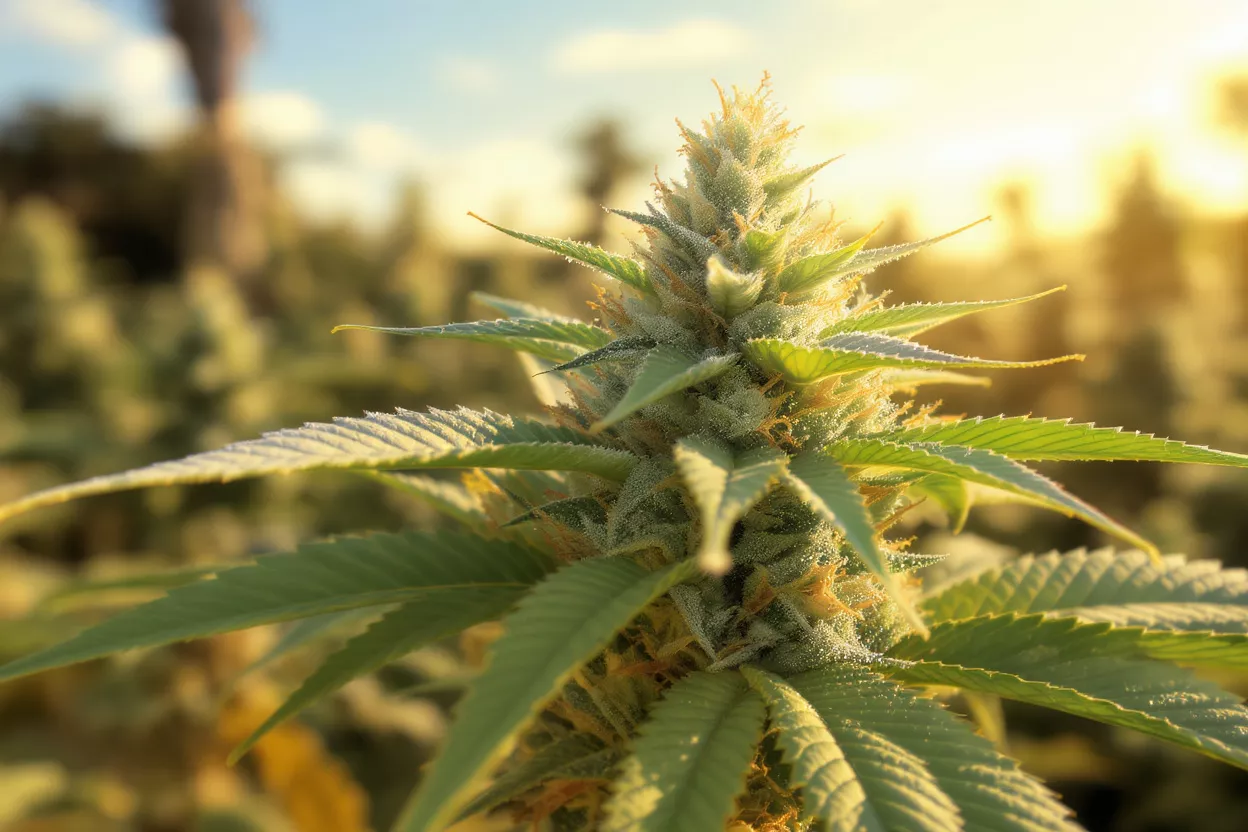
Cannabis builds its phytocannabinoids inside tiny resin glands called trichomes, the frosty crystals that coat mature flower. These structures are the plant's chemical factories, and their density is one reason high-resin cultivars look so sticky and sparkling under light.
The role of CBGA is central to the entire process. Cannabigerolic acid, the acidic form of CBG, is often called the mother cannabinoid because plant enzymes convert it into the acidic precursors of THC, CBD, and CBC. Which enzyme a given plant expresses, determined by its genetics, dictates whether it becomes a THC-dominant or CBD-dominant cultivar.
Decarboxylation is the final step that turns raw plant material into something psychoactive. When cannabis is heated through smoking, vaping, or baking, the acidic precursors lose their carboxyl group and convert into the active forms your body responds to. This is why eating raw flower will not get you high, but a properly baked edible will.
Major Phytocannabinoids: THC and CBD
THC and CBD are the headline phytocannabinoids, and understanding their differences clears up most of the confusion newcomers experience. Both come from the same plant and the same precursor, yet they produce strikingly different experiences because of how they engage the body's receptors.
THC, the intoxicating one, binds strongly to CB1 receptors in the brain, producing the euphoria, altered perception, and appetite stimulation cannabis is known for. It is the compound responsible for the classic "high," and its concentration is what most consumers check first when choosing a product.
CBD, the balancing one, does not produce intoxication and in some cases tempers the intensity of THC. It has drawn enormous research interest for its potential roles in anxiety, seizure disorders, and inflammation. Many wellness-focused products lean on CBD precisely because it offers effects without the cognitive impairment.
Minor Phytocannabinoids Worth Knowing
Beyond the two famous compounds lies a growing list of minor phytocannabinoids that researchers and product developers are increasingly excited about. They appear in smaller concentrations, but advances in extraction and breeding are making them more accessible than ever.
CBG and CBN are two of the most discussed. CBG is the non-intoxicating mother cannabinoid being studied for potential antibacterial and anti-inflammatory properties. CBN forms as THC ages and oxidizes, and it is frequently marketed in sleep products, though the sedation evidence remains preliminary.
A few minor phytocannabinoids stand out for their distinct profiles:
- 🌼 CBC: non-intoxicating, studied alongside THC and CBD for inflammation and mood.
- ⚡ THCV: may modulate appetite and produces a clear-headed, short-lived effect at higher doses.
- 🌙 CBN: an oxidation product often paired with THC in nighttime formulas.
- 🌱 CBG: the precursor compound now bred into dedicated high-CBG cultivars.
Phytocannabinoid Benefits and Research
The therapeutic interest in phytocannabinoids spans a remarkable range of conditions, though it is important to separate established science from early-stage promise. The only cannabis-derived medication with broad regulatory approval is a purified CBD formulation used for rare, severe forms of epilepsy, which demonstrates how seriously these compounds are now taken.
Pain and inflammation remain the most common reasons people turn to cannabis. Because cannabinoid receptors are densely involved in pain signalling and immune regulation, phytocannabinoids can influence how the body perceives and processes discomfort. Clinical evidence is strongest for certain neuropathic and chronic pain states.
Research is also exploring roles in anxiety, sleep, nausea, and appetite. Much of this work is ongoing, and the honest position is that phytocannabinoids show genuine promise without being a cure-all. Reputable guidance always emphasizes starting low, going slow, and consulting a clinician for any serious medical condition.
The Entourage Effect Explained
One of the most discussed ideas in cannabis science is the entourage effect, the theory that phytocannabinoids work better together than in isolation. According to this model, the full spectrum of compounds in a cannabis plant produces a richer, more nuanced effect than any single isolated molecule.
The role of terpenes is central to this idea. The aromatic terpenes that give each cultivar its smell may subtly shape how phytocannabinoids feel, modulating absorption, mood, and intensity. This is why a full-spectrum extract is thought to behave differently from a pure THC or CBD isolate.
The entourage effect is widely embraced in the industry but still being rigorously tested in laboratories. The plausible mechanism and abundant anecdotal support make it compelling, yet careful researchers caution that the clinical evidence is still maturing. It is best understood as a promising framework rather than settled fact.
Are Phytocannabinoids Safe?
Phytocannabinoids have a generally favourable safety profile, especially compared with many common pharmaceuticals. There is no known lethal overdose level for THC or CBD in the way there is for opioids, and most adverse effects are uncomfortable rather than dangerous. That said, "favourable" is not the same as "risk-free."
Common side effects of THC-dominant products include anxiety, rapid heart rate, dry mouth, and impaired coordination, particularly at higher doses. CBD is better tolerated but can cause drowsiness, appetite changes, and importantly can interact with other medications by affecting liver enzymes. Anyone taking prescription drugs should consult a pharmacist or physician.
Phytocannabinoids are powerful, plant-derived tools that engage one of the body's most fundamental regulatory systems. From the famous duo of THC and CBD to the growing roster of minor compounds, these molecules explain why cannabis affects us the way it does. Understanding their origins, their mechanisms, and their evolving science lets you approach cannabis with curiosity and respect rather than confusion. Start low, learn the compounds in your products, and let evidence rather than hype guide your choices.



Comments