Capsules for Pain: Daily Cannabis Relief in Capsule Form
Capsules for pain offer pre-measured, long-lasting cannabis relief without smoke or guesswork.
Living with persistent discomfort changes how you approach every part of your day, and finding a discreet, measured way to manage it matters. Capsules for pain have become one of the most popular ways to incorporate cannabis into a daily wellness routine, offering pre-measured doses without the smoke, the guesswork, or the lingering aroma. For people who want consistency above all else, swallowing a capsule feels familiar—no different from any other supplement in the morning lineup.
Unlike a quick puff or a sublingual tincture, capsules for pain deliver cannabinoids through the digestive system, producing effects that arrive slowly and last for hours. This makes them especially appealing for chronic conditions where steady, all-day relief matters more than rapid onset. Throughout this guide, we'll unpack how they work, how to dose them, and how to choose a product that genuinely fits your needs.
What Are Capsules for Pain
Capsules for pain are oral cannabis products that encapsulate active cannabinoids—typically THC, CBD, or a blend of both—inside a digestible shell. The shell is usually gelatin or a plant-based alternative, and inside it you'll find a measured amount of cannabis-infused oil, distillate, or full-spectrum extract suspended in a carrier. Because the dose is fixed and printed on the label, you always know exactly how many milligrams you're taking, which removes the estimation that comes with smoking or eyeballing an edible.
What separates capsules from other edibles: A gummy or cannabis baked good is something you taste, chew, and enjoy, which means flavor and texture influence the experience. A capsule is purely functional. You swallow it whole, it bypasses your palate entirely, and the only variable that matters is the cannabinoid content. For someone managing pain who doesn't want sugar, calories, or the ritual of eating something sweet, this clinical simplicity is the entire appeal.
The cannabinoids inside capsules can come from various extraction methods, including BHO (butane hash oil) and CO2 extraction. According to Forbes, the cannabis wellness market has expanded rapidly as more consumers seek alternatives to traditional pain management, and standardized formats like capsules sit at the center of that shift toward predictable, repeatable dosing.
How Do Capsules for Pain Work in the Body
When you swallow a capsule, it travels to your stomach and small intestine, where the shell dissolves and releases the cannabinoid oil. From there, the active compounds are absorbed into your bloodstream and pass through the liver before circulating throughout your body. This first-pass metabolism is the defining feature of any oral cannabis product and explains why capsules behave so differently from inhaled methods.
Why onset takes longer: Because the cannabinoids must travel through your digestive tract and liver, you won't feel anything for 30 to 90 minutes. The trade-off for that patience is duration—effects often last six to eight hours, far longer than the one to three hours you'd get from vaping a cannabis disposable vape. For pain that persists through the workday or disrupts sleep, that extended window is precisely the point.
The liver also transforms THC into a more potent metabolite, which is why oral products can feel stronger per milligram than you might expect. Your endocannabinoid system—a network of receptors involved in regulating pain, mood, and inflammation—is where these compounds ultimately do their work, binding to receptors and modulating the signals your body interprets as discomfort.
Types of Capsules for Pain Explained
Not all capsules are built the same, and the cannabinoid profile inside determines the experience you'll have. Understanding the main categories helps you match a product to your specific kind of pain and your tolerance for psychoactive effects.
- 🌿 Full-spectrum capsules: Contain the complete range of cannabinoids and terpenes—including compounds like borneol and carene—producing the entourage effect where everything works together.
- 💧 Broad-spectrum capsules: Retain most beneficial compounds but remove detectable THC, ideal for those who want minimal psychoactivity.
- 🧪 CBD isolate capsules: Pure CBD with nothing else, offering total predictability and zero THC.
- ⚖️ Balanced THC:CBD capsules: A measured ratio like 1:1, blending relief with manageable effects.
How carriers and additives matter: Beyond the cannabinoids themselves, the carrier oil influences absorption. Many capsules use a cannabis-infused oil base like MCT or olive oil, which helps the fat-soluble cannabinoids absorb more efficiently. Some formulas also include stabilizers such as carrageenan in liquid-gel versions to keep the contents uniform. If you're sensitive to certain additives, the ingredient list deserves a close read before you buy.
Terpene content also shapes the effect. A capsule rich in certain aromatic compounds may lean more relaxing or more uplifting depending on its profile, which is why two products with identical THC content can feel noticeably different. For first-time users, a low-dose CBD capsule offers the gentlest entry point.
Capsules for Pain vs Other Cannabis Methods
Choosing capsules over another format comes down to what you value most: speed, duration, discretion, or precision. Each delivery method has a clear personality, and pain sufferers often keep more than one on hand for different situations.
Capsules versus inhalation: Smoking or vaping delivers relief within minutes, which suits breakthrough pain that flares suddenly. But the effects fade quickly, and inhaling carries respiratory considerations that not everyone wants. Capsules trade that speed for hours of steady coverage and zero impact on your lungs—a meaningful difference for daily, long-term use.
Compared to other edibles, capsules win on precision and neutrality. A cannabis lollipop or cannabis jelly delivers cannabinoids through the same digestive route, but with added sugar and inconsistent dosing if you only eat part of it. Capsules also outshine sublingual tinctures for people who dislike the herbal taste or the wait of holding oil under the tongue. The trade-off is onset speed, since tinctures absorb partly through the mouth and act faster.
- ⏱️ Onset: Capsules 30–90 min vs inhalation 2–10 min vs tinctures 15–45 min.
- 🕐 Duration: Capsules 6–8 hrs vs inhalation 1–3 hrs vs gummies 4–6 hrs.
- 🎯 Dosing precision: Capsules highest; smoking lowest.
- 🤫 Discretion: Capsules win—no smell, no equipment.
Capsules for Pain Dosing Guide for Beginners
Dosing is where capsules truly shine, because the milligram count is fixed and reproducible every single time. That said, finding your personal effective dose still requires a thoughtful approach, especially if you're new to oral cannabis.
Start low and go slow: Begin with a low dose—often 2.5 to 5 mg of THC, or 10 to 25 mg of CBD—and wait a full two hours before considering more. Because oral onset is delayed, the biggest beginner mistake is taking a second capsule too soon, then feeling overwhelmed when both kick in at once. Patience is non-negotiable with this format.
Once you know how a given dose affects you, you can adjust upward gradually over several days. Many people managing chronic pain settle into a routine of one capsule in the morning and one in the evening, creating steady cannabinoid levels throughout the day. A consistent schedule often outperforms sporadic larger doses for sustained relief. Keeping a simple log of dose and effect helps you dial in the sweet spot.
- 🟢 Microdose: 2.5 mg THC — subtle relief, fully functional.
- 🟡 Low: 5–10 mg THC — noticeable relief for mild to moderate pain.
- 🟠 Moderate: 10–20 mg THC — for experienced users with higher tolerance.
- 🔵 CBD-focused: 25–50 mg CBD — non-intoxicating, anti-inflammatory.
Benefits of Capsules for Pain for Daily Relief
The strongest argument for capsules is consistency. When the dose never varies, you can build a reliable routine and actually evaluate whether cannabis is helping your pain over time—something that's nearly impossible when every smoking session or homemade edible delivers a different amount.
Discretion that fits any setting: A capsule looks like any other supplement, produces no odor, and requires no preparation. You can take one at work, while traveling, or in any situation where the ritual of cannabis would feel out of place. For professionals and parents managing pain quietly, this invisibility is a genuine benefit rather than a minor convenience.
The long duration also reduces how often you have to think about your medication. Instead of redosing every couple of hours, you take a capsule and move on with your day. This is particularly valuable overnight, where a single evening dose can support uninterrupted sleep. Pairing capsules with topical options like a fast-acting pain relief balm lets you address both systemic and localized discomfort. According to Forbes, demand for non-inhaled cannabis formats continues to climb as wellness-minded consumers prioritize convenience and discretion.
Best Capsules for Pain for Chronic Conditions
Chronic pain—whether from arthritis, neuropathy, fibromyalgia, or long-term injury—responds best to steady, sustained cannabinoid levels, which is exactly what capsules deliver. For these conditions, a balanced or CBD-forward formula often works better than a high-THC product, because it provides anti-inflammatory support without heavy intoxication that interferes with daily life.
Matching formula to condition: Inflammatory pain conditions tend to respond well to higher CBD ratios, while nerve-related pain sometimes benefits from a touch more THC. There's no universal answer, which is why many people experiment with a 1:1 balanced capsule first, then shift the ratio based on results. A balanced 1:1 capsule is a sensible starting point for most chronic pain sufferers.
Consistency over weeks, not days, is what reveals a capsule's true value for chronic conditions. Cannabinoids can build a cumulative effect in the body, and many users report that benefits deepen after a sustained routine. It's also worth noting that overuse of high-THC products can occasionally trigger cannabinoid hyperemesis syndrome in susceptible individuals, another reason a measured, CBD-leaning approach often suits long-term management best.
Are Capsules for Pain Safe to Use
For most adults, cannabis capsules are a well-tolerated way to manage pain, but safety always depends on responsible use and awareness of your own health profile. The encapsulated format actually adds a layer of safety by removing the dosing guesswork that leads to accidental overconsumption with other products.
Possible side effects: The most common issues are drowsiness, dry mouth, and—at higher THC doses—temporary anxiety or dizziness. Because oral cannabis hits harder per milligram and lasts longer, an overshot dose feels uncomfortable for hours rather than minutes. This is precisely why the start-low principle matters so much with capsules. Side effects are usually mild and resolve as the dose wears off.
Anyone taking prescription medications should consult a healthcare provider first, since cannabinoids can interact with the same liver enzymes that metabolize many drugs. Pregnant or breastfeeding individuals should avoid cannabis entirely. Keep capsules stored safely away from children, since their pill-like appearance makes them easy to mistake for ordinary medication. Used thoughtfully, capsules remain one of the safer and most controllable ways to bring cannabis into a pain-management routine.
How to Choose Capsules for Pain
With so many products on the market, picking the right capsule comes down to a few decisive factors: cannabinoid ratio, lab testing, carrier quality, and dosage precision. Getting these right means the difference between a product that genuinely helps and one that disappoints.
Always check the lab results: Reputable capsules come with a certificate of analysis confirming the cannabinoid content and screening for pesticides, solvents, and heavy metals. This matters even more with extract-based products, since methods like BHO (butane hash oil) extraction must be properly purged of residual solvents. If a brand can't show you third-party testing, walk away.
Consider the cannabinoid ratio that fits your goals, the type of carrier oil used, and whether you want full-spectrum complexity or isolate simplicity. Beginners generally do well starting with a lower-potency, CBD-forward option and adjusting from there. A full-spectrum hemp softgel suits those who want the entourage effect, while isolate capsules suit anyone who must avoid THC entirely.
- 🔬 Third-party tested: Always verify a current certificate of analysis.
- 🌱 Quality carrier: Look for MCT or olive oil bases for better absorption.
- 📋 Clear labeling: Exact milligrams per capsule, not vague ranges.
- ⚖️ Right ratio: Match THC:CBD to your pain type and tolerance.


Phoenix Tears Capsules 50mg x 30pcs – NOW+THEN
Now+Then's Phoenix Tears capsules take full-spectrum RSO and put it in a precise, swallow-and-go format — no syringes, no guesswork, no taste. Each capsule carries a substantial 50mg of full-spectrum oil suspended in MCT, with thirty per bottle for a full month's supply. This is the high-dose end of the range, made for experienced users who already know their tolerance and want consistency from one capsule to the next. The full-spectrum oil keeps the plant's broader cannabinoid and terpene profile intact, and the capsule format means clean, repeatable dosing wherever the evening takes you.
- 50mg full-spectrum RSO per capsule, 30 per bottle (a month's supply)
- Precise, repeatable dosing — no syringes or measuring
- Tasteless, swallow-and-go capsules suspended in MCT oil
- Full-spectrum oil retains the plant's broader cannabinoid profile
- High-dose option suited to experienced users who know their tolerance

Relief CBD Capsules 25mg x 30pcs – BIRCH+FOG
Targeted comfort, precisely dosed. Each of these 30 capsules pairs 25mg of premium CBD with anti-inflammatory botanicals to take the edge off everyday aches — sore joints, stiff muscles, the dull weight of a long day on your feet. Easy to swallow and easy to schedule, they bring measured, repeatable relief to your routine without creams, drops, or guesswork.
- Pain Reduction : Addresses discomfort at the source
- Inflammation Control : Reduces swelling and irritation
- Joint Support : Improves mobility and flexibility
- Muscle Recovery : Speeds post-exercise healing
- Headache Relief : Eases tension and migraine pain

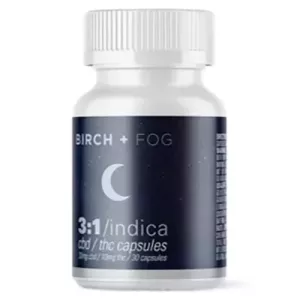
Nighttime Indica Capsules 30mg CBD 10mg THC x 30 Caps – BIRCH+FOG
Drift into restful nights with BIRCH+FOG's Nighttime Indica Capsules, each delivering a calibrated 3:1 ratio of 30mg CBD to 10mg indica THC for gentle, plant-based relaxation. The generous CBD content helps quiet racing thoughts while the indica THC eases you toward deep, comfortable rest, complemented by soothing terpenes like myrcene and linalool that encourage drowsiness and muscle release. Effects typically settle in within 45 to 90 minutes and carry you through 6 to 8 hours of quality sleep. Precisely dosed and reliable, they're a calm, consistent companion for winding down night after night.
- Deep Sleep Induction : Indica terpenes and cannabinoids promote faster sleep onset and deeper rest
- Sleep Cycle Support : Helps achieve more restorative REM and deep sleep phases
- Pain Relief : Nighttime pain management allows uninterrupted sleep through the night
- Anxiety Reduction : CBD calms mental chatter that prevents falling asleep
- Natural Sedation : Plant-based formula works with body's natural sleep mechanisms
Capsules for Pain Common Questions Answered
New users tend to ask the same practical questions, so here are clear answers to the most common ones about using capsules for pain effectively and safely.
How long until they start working? Expect 30 to 90 minutes for onset, depending on your metabolism and whether you've eaten. Taking a capsule with a small amount of fat-containing food can improve absorption and may produce a slightly stronger, more consistent effect. Never redose within the first two hours, no matter how impatient you feel.
Can you take them every day? Yes—daily use is exactly what capsules are designed for, and many chronic pain patients build a twice-daily routine. As with any cannabis product, tolerance can develop over time, so occasional breaks help keep your effective dose low. If you find yourself needing steadily more for the same relief, a short pause often resets your sensitivity.
Capsules for pain represent one of the most practical, predictable ways to bring cannabis into a daily wellness routine. They trade the speed of inhalation for hours of steady, discreet relief, deliver precise doses every time, and fit seamlessly into the rhythm of ordinary life. Whether you're managing chronic inflammation, nerve pain, or sleep disruption, starting low, staying consistent, and choosing lab-tested products will set you up for the best possible results. With a thoughtful approach, capsules can become a quiet, reliable cornerstone of long-term pain management.