
CBD for Sleep: Does It Help and How to Use It
Learn if CBD sleep aids actually work, how much to take, and the best formats for rest.
What Is CBD for Sleep and How Does It Work
If you have spent the small hours of the morning staring at the ceiling, you have probably wondered whether CBD for sleep is more than wellness marketing. Cannabidiol, the non-intoxicating compound found in hemp, has become one of the most searched-for natural sleep aids of the past decade. Unlike THC, it does not produce a high, which is precisely why so many people who would never touch ganja are comfortable trying it before bed.
CBD interacts with the body through the endocannabinoid system, a network of receptors that helps regulate mood, pain, appetite, and crucially, the sleep-wake cycle. Rather than acting as a sedative the way a sleeping pill does, cannabidiol appears to nudge the body toward balance. According to WebMD, CBD may help address some of the root causes that keep people awake, such as anxiety and chronic discomfort, rather than simply forcing the brain into unconsciousness.
Why hemp-derived CBD matters for sleep: The plant chemistry behind a quality extract is more nuanced than a single molecule. Skilled producers, sometimes called extraction artists, preserve aromatic terpenes like humulene that may complement CBD's calming reputation. The genotype of the hemp plant, the growing method whether soil or hydroponics, and the care taken during processing all shape the final product you place under your tongue at night.
Does CBD Help You Sleep According to Research
What the studies actually show: The honest answer is that CBD for sleep is promising but still being investigated. A frequently cited case series found that the majority of patients reported improved sleep scores within the first month of use, though those improvements sometimes fluctuated over time. Researchers generally agree the strongest evidence points to CBD's indirect benefits, easing the anxiety and pain that disrupt rest, rather than a direct sedative knockout effect.
Context matters enormously when interpreting these findings. Many trials use varying doses, formulations, and participant profiles, which makes head-to-head comparison difficult. The work published through WebMD notes that while early results are encouraging, larger and longer studies are needed before anyone can claim CBD is a guaranteed remedy for insomnia.
That uncertainty does not mean the compound is ineffective. Plenty of users report meaningful improvement, and the placebo-controlled gap is narrowing as research matures. For people who have struggled with conventional sleep aids and their grogginess, a well-formulated full-spectrum CBD oil offers a low-risk avenue worth exploring under the guidance of a healthcare provider.
How CBD Affects Your Sleep Cycles
Sleep is not a single uniform state. Over the course of a night you cycle through light sleep, deep slow-wave sleep, and REM sleep, each serving a distinct restorative purpose. Understanding how CBD interacts with these stages helps explain why some people feel transformed by it while others notice little change.
The deep sleep connection: Some research suggests CBD may increase time spent in deep, slow-wave sleep, the phase most associated with physical recovery and feeling genuinely rested. This is meaningfully different from sedatives that increase total sleep time but suppress the restorative architecture beneath it. The distinction is why a person can sleep eight hours on certain medications and still wake exhausted.
CBD's relationship with REM sleep is more complicated and dose-dependent. Lower doses may promote alertness while higher doses lean sedating, a biphasic quirk that catches many newcomers off guard. This is also why finding your personal sweet spot matters more than chasing the highest dose available.

- 🌙 Deep sleep: CBD may support more time in restorative slow-wave stages tied to physical recovery.
- 💤 Sleep onset: By easing anxiety, cannabidiol can shorten the time it takes to drift off.
- 🔄 REM balance: Effects on dream sleep are dose-dependent and still under study.
- ⏰ Fewer wakeups: Some users report less nighttime tossing and more continuous rest.
Best CBD for Sleep Formats and Products
The format you choose shapes how quickly CBD takes effect and how long it lasts, two factors that matter enormously for sleep. Someone who struggles to fall asleep needs a fast-acting delivery, while someone who wakes repeatedly may benefit from a slow-release option that carries them through the night.
Oils and tinctures: Held under the tongue, these absorb through the mucous membranes and take effect within fifteen to forty-five minutes, making them a flexible choice for sleep onset. Quality oils rely on a carefully chosen excipient or carrier such as MCT, and many include lecithin to improve how the hydrophilic and oil-based components blend for absorption.
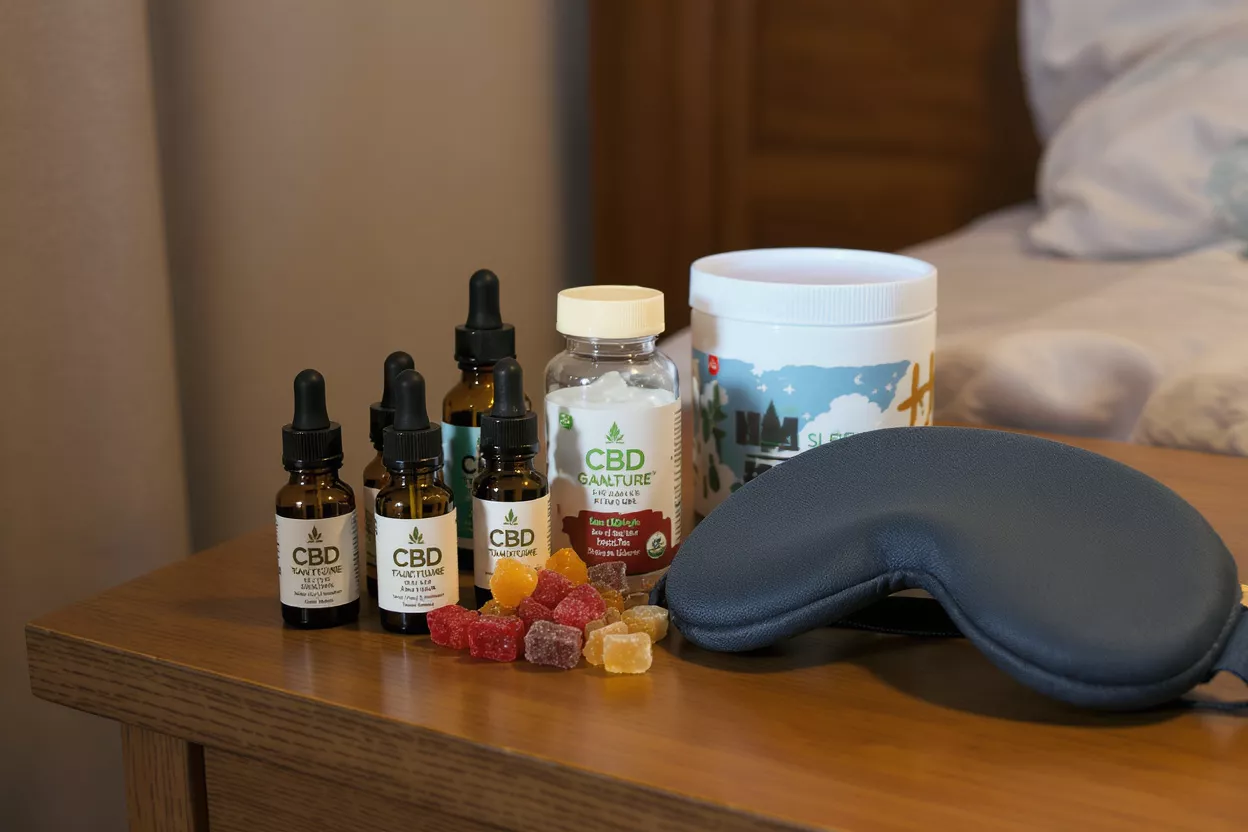
Edibles and capsules travel a different path. Because they pass through the digestive system, they take longer to kick in, sometimes ninety minutes, but the effects last far longer, which suits people whose problem is staying asleep rather than falling asleep. For evening use, many people prefer CBD sleep gummies with melatonin that pair the two compounds in a single measured dose.
- 🌿 Tinctures: Fast onset, easy to micro-dose, ideal for trouble falling asleep.
- 🍬 Gummies and edibles: Slow, long-lasting, best for staying asleep through the night.
- 💊 Capsules: Precise, consistent dosing with no measuring required.
- 🌬️ Vapes: Fastest onset but shortest duration, less suited to overnight relief.
CBD for Sleep Dosing Guide
Start low and go slow: The most reliable guidance for CBD for sleep is to begin with a modest dose, often fifteen to twenty-five milligrams, taken thirty to sixty minutes before bed. From there you adjust gradually over several nights, watching how your body responds rather than jumping to a large amount on the first try. Because of CBD's biphasic nature, more is not automatically better.
Body weight, metabolism, and the underlying reason for your sleeplessness all influence the ideal amount. According to WebMD, individual response to cannabidiol varies considerably, so the dose that transforms one person's nights may do little for another. Keeping a simple sleep journal for a week or two removes much of the guesswork.
Consistency tends to matter more than precision. CBD appears to work best when taken at the same time each night, allowing levels to stabilize rather than spiking and crashing. If you reach a higher dose without benefit, the issue may not be quantity, it may be product quality, formulation, or an underlying condition that deserves a doctor's attention.
CBD vs Melatonin for Sleep
Melatonin and CBD are often mentioned in the same breath, but they work in fundamentally different ways. Melatonin is a hormone your body already produces to signal that night has arrived, essentially telling your brain it is time to wind down. It excels at resetting a disrupted body clock, such as after travel or shift work.
Different problems, different tools: CBD does not signal nighttime the way melatonin does. Instead it works on the anxiety, racing thoughts, and physical discomfort that keep people from relaxing in the first place. This is why someone whose mind will not switch off may respond better to CBD, while someone whose schedule is simply misaligned may find melatonin more effective.
Many modern formulas combine the two precisely because they address different obstacles. The melatonin handles the timing signal while the CBD addresses the tension, and together they cover more ground than either alone. For people juggling both racing thoughts and an irregular schedule, a combined broad-spectrum sleep tincture can be a sensible starting point.
CBD Sleep Benefits Beyond Rest
Better sleep rarely stays confined to the bedroom. When rest improves, the benefits ripple outward into mood, focus, and physical wellbeing during the day. This cascade is part of why CBD has attracted such broad interest beyond the niche of chronic insomniacs.
The anxiety and recovery angle: Because CBD's sleep benefits often stem from reduced anxiety, many users notice calmer days alongside calmer nights. Athletes and active people, meanwhile, value the deeper recovery that quality sleep enables, since slow-wave sleep is when much physical repair occurs. The terpenes in full-spectrum products, from fenchol to geranyl-derived aromatics, may subtly contribute to this overall sense of ease.
It is worth separating genuine benefit from hype. CBD is not a cure-all, and the most credible improvements are modest and cumulative rather than dramatic and instant. The work summarized by WebMD emphasizes that wellbeing gains tend to build over weeks of consistent use, not overnight.

Is CBD for Sleep Safe to Use Nightly
For most healthy adults, CBD is considered well tolerated, even with nightly use. It does not carry the dependency risk associated with many prescription sleep medications, and it does not produce the morning fog that benzodiazepines and similar drugs are notorious for. This favorable safety profile is a major reason people are willing to try it long term.
Drug interactions to respect: The most important caveat is that CBD can interfere with how the liver metabolizes certain medications, the same grapefruit-warning enzymes you may have seen on prescription labels. If you take blood thinners, seizure medication, or any drug with a narrow safety margin, a conversation with your doctor is non-negotiable before adding nightly cannabidiol.
Quality also governs safety. Poorly made products may contain residual solvents, heavy metals, or inaccurate labeling, which is why third-party lab testing is essential. Look for a certificate of analysis confirming both potency and purity, and favor brands transparent about their sourcing, whether the hemp was grown in soil or hydroponics.
How to Use CBD for Better Sleep
Getting results from CBD is as much about routine as it is about the compound itself. Taking a dose in isolation, while still scrolling your phone in a bright room at midnight, undercuts even the best product. CBD works best as one component of a deliberate wind-down ritual.
Building a sleep-friendly routine: Take your CBD at a consistent time each evening, dim the lights, and step away from screens to let your natural melatonin rise. Pair the dose with calming cues your brain can learn to associate with sleep, the same room temperature, the same gentle stretch, the same quiet space. Over time these signals compound with the CBD's effects.
Track what works and refine slowly. Note your dose, the format you used, the time you took it, and how you slept. The clearer your record, the faster you home in on your personal formula. The list below distills the essentials into a repeatable nightly checklist.
- 🕯️ Same time nightly: Take CBD thirty to sixty minutes before your target bedtime.
- 📵 Cut the screens: Dim lights and avoid blue light to let melatonin rise naturally.
- 📓 Keep a journal: Log dose, format, and sleep quality to find your sweet spot.
- 🛏️ Consistent environment: Cool, dark, quiet rooms reinforce the CBD's effects.

CBD for Sleep Side Effects and Cautions
CBD's side effect profile is generally mild, but it is not nonexistent, and honesty about that builds trust. The most commonly reported effects are drowsiness, dry mouth, mild digestive upset, and occasional changes in appetite. For a sleep aid, drowsiness is arguably a feature rather than a bug, though it can linger into the morning at higher doses.
Dry mouth is easily managed by keeping water nearby, and digestive complaints often fade as your body adjusts or when you take CBD with food. According to WebMD, these effects are usually temporary and dose-related, easing when you reduce the amount you take. Pregnant or breastfeeding individuals should avoid CBD entirely given the lack of safety data.
Used thoughtfully, CBD for sleep represents a low-risk, increasingly well-studied tool for people seeking more restful nights without the heavy baggage of traditional sleep medications. It is not a miracle, and it works best alongside good sleep habits rather than in place of them. Start with a quality, lab-tested product, begin with a modest dose, stay consistent, and loop in your doctor if you take other medications. With patience and a little experimentation, many people find that better sleep is genuinely within reach.