


Agonist
Discover what an agonist does in cannabis pharmacology.
What Is an Agonist in Cannabis
The term agonist cannabis describes one of the most fundamental concepts in cannabinoid pharmacology, yet it rarely gets explained in plain language for everyday consumers. In simple terms, an agonist is a molecule that binds to a receptor and activates it, triggering a biological response. When you feel the effects of cannabis — whether euphoria, relaxation, pain relief, or appetite stimulation — you are experiencing the downstream result of agonists docking onto receptors throughout your nervous system and beyond.
The word itself comes from the Greek "agon," meaning a contest or struggle, and in pharmacology it refers to a compound that produces action. A cannabis agonist is any cannabinoid — natural or synthetic — that switches on a receptor the way a key turns in a lock. Without agonists, the receptors of your endocannabinoid system would sit idle, and cannabis would have no measurable effect on the body or mind.
Understanding this single concept unlocks a deeper appreciation of why different cannabis products feel so different from one another. The strength of an agonist, the receptor it prefers, and how tightly it binds all shape the experience you ultimately feel. This guide breaks down the science without the jargon overload, so the next time you read a product description mentioning receptor activity, you will know exactly what is happening inside you.
How Cannabis Agonists Work in the Body
Cannabis agonists operate through the endocannabinoid system, a vast signalling network that helps regulate mood, pain, appetite, sleep, memory, and immune function. Receptors in this system sit on the surface of cells, waiting for the right molecule to arrive. When an agonist binds, it changes the receptor's shape, which sets off a cascade of chemical messages inside the cell. That cascade is what ultimately produces the sensations and physiological shifts associated with cannabis.
Binding affinity determines how strongly and how readily a cannabinoid attaches to its target receptor. A compound with high affinity grabs the receptor easily and stays attached longer, often producing more pronounced effects. THC, the primary intoxicating cannabinoid, has notable affinity for one particular receptor type, which is why even modest doses can shift perception and mood so noticeably.

Intrinsic activity is the second piece of the puzzle. Two agonists can both bind the same receptor, but one might activate it fully while the other only nudges it partway. This distinction explains why some cannabinoids feel powerful and psychoactive while others remain gentle and clear-headed despite engaging the very same receptors. The combination of affinity and activity is the true fingerprint of any cannabis compound.
Full Agonist vs Partial Agonist Cannabis
Not all agonists are created equal, and the distinction between full and partial agonists is essential for understanding cannabis effects. A full agonist activates a receptor to its maximum capacity, producing the strongest possible response that receptor can deliver. A partial agonist binds the same site but generates only a fraction of that maximum response, even when every available receptor is occupied.
THC behaves as a partial agonist at the CB1 receptor, which surprises many people who assume the most famous psychoactive cannabinoid would max out its target. Because it only partially activates the receptor, THC's effects, while significant, are self-limiting in a way that pure full agonists are not. This partial activation is one reason natural cannabis has a different safety profile than certain laboratory-made compounds.
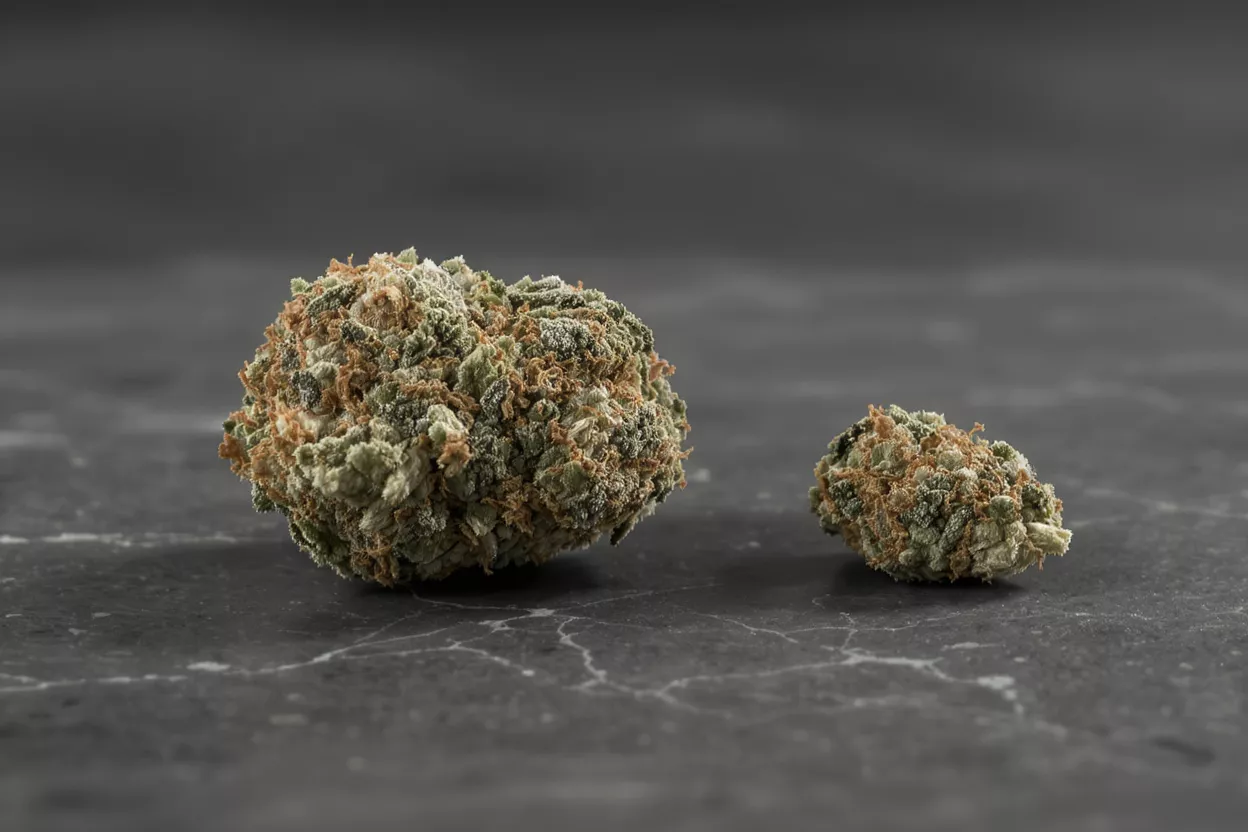
The practical takeaway is that the label "agonist" alone does not tell you how intense a compound will feel. Here is how the categories compare:
- 🔑 Full agonist: activates the receptor to its ceiling, producing the maximum biological response possible.
- 🌿 Partial agonist: binds the receptor but delivers only a portion of the full effect, often gentler and self-limiting.
- ⚖️ Affinity matters: a high-affinity partial agonist can still feel strong because it occupies receptors readily.
- 🧪 Synthetic full agonists: tend to be far more potent and unpredictable than natural cannabinoids.
Types of Cannabinoid Agonist Compounds
Cannabinoid agonists fall into three broad families, each with its own origin and behaviour. Understanding these categories helps clarify why a homegrown flower, a hemp-derived extract, and a research-grade chemical can all be called agonists yet behave in wildly different ways inside the body.
Phytocannabinoids are the plant-made agonists most consumers know. THC and CBD are the headliners, but the cannabis plant produces dozens of minor cannabinoids that also interact with receptors to varying degrees. These compounds have co-evolved with human biology, which partly explains why they tend to produce balanced, tolerable effects compared to engineered alternatives.
Endocannabinoids are the agonists your own body manufactures on demand. Anandamide and 2-AG are the two best understood, and they activate the same receptors that plant cannabinoids target. When researchers describe cannabis as "mimicking" natural signalling, this is what they mean — phytocannabinoids slot into a system already designed to receive agonists of this shape.
The third family is synthetic cannabinoids, laboratory creations engineered to bind cannabinoid receptors. Some were developed legitimately for research, while others appear illicitly in unregulated products. Many synthetics are full agonists with extreme potency, a combination that makes them far riskier than the partial-agonist cannabinoids found in regulated cannabis.
Agonist vs Antagonist at Cannabis Receptors
To fully grasp what an agonist does, it helps to understand its opposite: the antagonist. While an agonist activates a receptor, an antagonist binds the same site and blocks it, preventing activation without producing a response of its own. Think of the agonist as the foot on the accelerator and the antagonist as a clamp that stops the pedal from moving at all.
There is also a third category worth knowing — the inverse agonist. This type of molecule binds the receptor and produces the opposite effect of an agonist, actively suppressing baseline receptor activity rather than simply blocking it. The distinction is subtle but important in pharmacology, where some cannabis-targeting medications are designed to work this way.

These opposing actions are not just academic. Drug developers exploit the agonist–antagonist relationship to design medicines that either boost or restrain cannabinoid signalling, depending on the therapeutic goal. A simplified comparison looks like this:
- 🟢 Agonist: binds and activates the receptor, triggering a biological response.
- 🔴 Antagonist: binds and blocks the receptor, preventing activation without any effect of its own.
- 🔵 Inverse agonist: binds and produces the opposite effect, suppressing baseline activity below normal.
Why the Agonist Concept Matters for Effects
Knowing how agonists behave gives you a practical lens for predicting how a cannabis product might feel. When a strain or extract is rich in a high-affinity partial agonist like THC, you can expect noticeable psychoactivity that nonetheless has a natural ceiling. Compounds with weaker receptor activity tend to feel subtler, contributing to the overall character of an experience without dominating it.
The entourage effect is closely tied to agonist behaviour. Cannabis contains many compounds that engage receptors with differing affinities and activities, and the way they overlap shapes the final sensation. Terpenes may also influence how cannabinoids interact with receptors, adding nuance that pure isolated agonists cannot replicate.
This is also why tolerance develops. With repeated exposure, receptors can downregulate, meaning the same agonist produces a smaller response over time. Understanding this helps consumers make sense of why effects diminish with heavy use and why a tolerance break can restore sensitivity to familiar products.
CB1 and CB2 Receptor Agonist Differences
The endocannabinoid system features two principal receptor types, and the receptor an agonist prefers dramatically shapes its effects. CB1 receptors cluster densely in the brain and central nervous system, while CB2 receptors appear mostly in immune tissue and the periphery. An agonist's selectivity for one over the other determines whether it feels intoxicating or primarily therapeutic.
CB1 agonists are responsible for the classic cannabis "high." Because CB1 receptors saturate brain regions governing mood, memory, and perception, compounds that activate them produce psychoactive effects. THC's partial agonism at CB1 is the molecular source of the experience most people associate with cannabis.

CB2 agonists tend toward anti-inflammatory and immune-modulating effects without the intoxication, since CB2 receptors sit away from the brain's perception centres. Researchers are intensely interested in selective CB2 agonists because they promise therapeutic benefit without the psychoactivity that complicates broader cannabinoid medicine. This receptor selectivity is one of the most active frontiers in cannabinoid science today.
Are Synthetic Cannabis Agonists Safe
Safety questions around agonists hinge almost entirely on the difference between natural and synthetic compounds. The partial agonists found in regulated cannabis have a long history of human use and a well-characterized, generally favourable safety profile. Synthetic full agonists are an entirely different matter and deserve serious caution.
Illicit synthetic cannabinoids — sometimes sold under street names and sprayed onto plant material — are frequently full agonists with potency many times that of THC. Because they activate CB1 receptors completely rather than partially, they can overwhelm the system and produce severe adverse reactions that natural cannabis simply does not cause. This is the clearest real-world example of why the full-versus-partial distinction matters.
The contrast underscores an important consumer lesson. Regulated, lab-tested cannabis products derive their effects from well-understood partial agonists, while unregulated synthetics gamble with unknown full agonists of unpredictable strength. Choosing tested products from a trusted source is the most reliable way to keep agonist activity within a safe, comfortable range.
Agonist Research and Medical Applications
The agonist framework is not just theoretical — it actively guides modern cannabinoid medicine. Pharmaceutical researchers design molecules to target specific receptors with specific intensities, aiming to capture therapeutic benefits while minimizing unwanted effects. The entire field of cannabinoid drug development is, at its core, a search for the right agonist for the right job.
Approved cannabinoid medications already rely on this principle. Some prescription products use compounds that engage CB1 receptors to address nausea or appetite loss, leveraging controlled agonism to deliver predictable clinical outcomes. The precision afforded by understanding agonist behaviour is what makes these treatments possible.
Looking ahead, selective agonists represent one of the most promising directions in the field. By tailoring a molecule's affinity, intrinsic activity, and receptor preference, scientists hope to develop therapies for pain, inflammation, neurological conditions, and more — all without the limitations of broad-spectrum compounds. The humble concept of the agonist sits at the heart of this entire endeavour.
Agonist Cannabis Terms You Should Know
Mastering a handful of related terms makes any discussion of agonist cannabis far easier to follow. These concepts appear constantly in scientific literature, product education, and cannabinoid medicine, and knowing them turns dense pharmacology into something approachable.
A quick vocabulary refresher ties together everything covered in this guide. Each term below builds on the agonist concept and helps explain why different cannabis compounds behave the way they do.
- 🔑 Affinity: how strongly and readily a compound binds to its receptor.
- ⚡ Intrinsic activity: how fully an agonist activates a receptor once bound.
- 🎯 Selectivity: a compound's preference for one receptor type over another.
- 🚫 Antagonist: a molecule that blocks a receptor without activating it.
- 🔄 Inverse agonist: a molecule producing the opposite of the agonist response.
- 📉 Downregulation: the receptor reduction behind cannabis tolerance.
Understanding agonists transforms how you read every cannabis label and research summary. From the partial agonism of THC at CB1 receptors to the immune-focused promise of selective CB2 agonists, this single concept connects the plant's effects, its safety profile, and the future of cannabinoid medicine. The next time a product description mentions receptor activity, you will recognize the elegant biology at work — and make more informed choices because of it.