Lipophilic
Discover what lipophilic means in cannabis science, how it affects absorption, and why it matters for edibles and topicals.
What Does Lipophilic Mean in Cannabis Science?
The term lipophilic describes a molecule's tendency to dissolve in fats, oils, and other non-polar substances rather than in water. In the context of lipophilic cannabis chemistry, this single property shapes nearly everything about how cannabinoids are extracted, formulated, absorbed, and ultimately experienced by the body. The word itself comes from the Greek roots meaning "fat-loving," and it sits at the heart of why cannabis products behave the way they do.
The chemistry behind the term is rooted in molecular polarity. Water is a polar solvent, meaning its molecules carry slight electrical charges that attract other charged or polar substances. Lipophilic molecules lack these charged regions, so they are repelled by water and instead mingle freely with oils and lipids. This is the same principle that explains why oil and vinegar separate in salad dressing, and it is exactly why cannabinoids cling to fatty tissues rather than dissolving into the bloodstream's watery plasma.
Nearly every active compound in cannabis falls into this category. The major cannabinoids and aromatic terpenes share this fat-loving character, which is precisely why understanding lipophilicity is foundational to making sense of how cannabis works.
Why Are Cannabinoids Lipophilic Molecules?
Cannabinoids are lipophilic because of their molecular architecture. Compounds like THC and CBD are built largely from carbon and hydrogen atoms arranged in ring structures and long hydrocarbon tails. These structures carry very few polar functional groups, leaving the molecule overwhelmingly non-polar and therefore strongly attracted to fats.
The role of the pentyl side chain is particularly important. THC and CBD both feature a five-carbon tail that dramatically increases their affinity for lipids. Researchers measure this affinity using a value called the partition coefficient, often written as logP. THC has a logP of roughly 6 to 7, an exceptionally high figure that confirms it would rather sit in oil than water by a factor of millions to one. This number is not a trivial statistic; it predicts how the compound moves through every biological barrier it encounters.
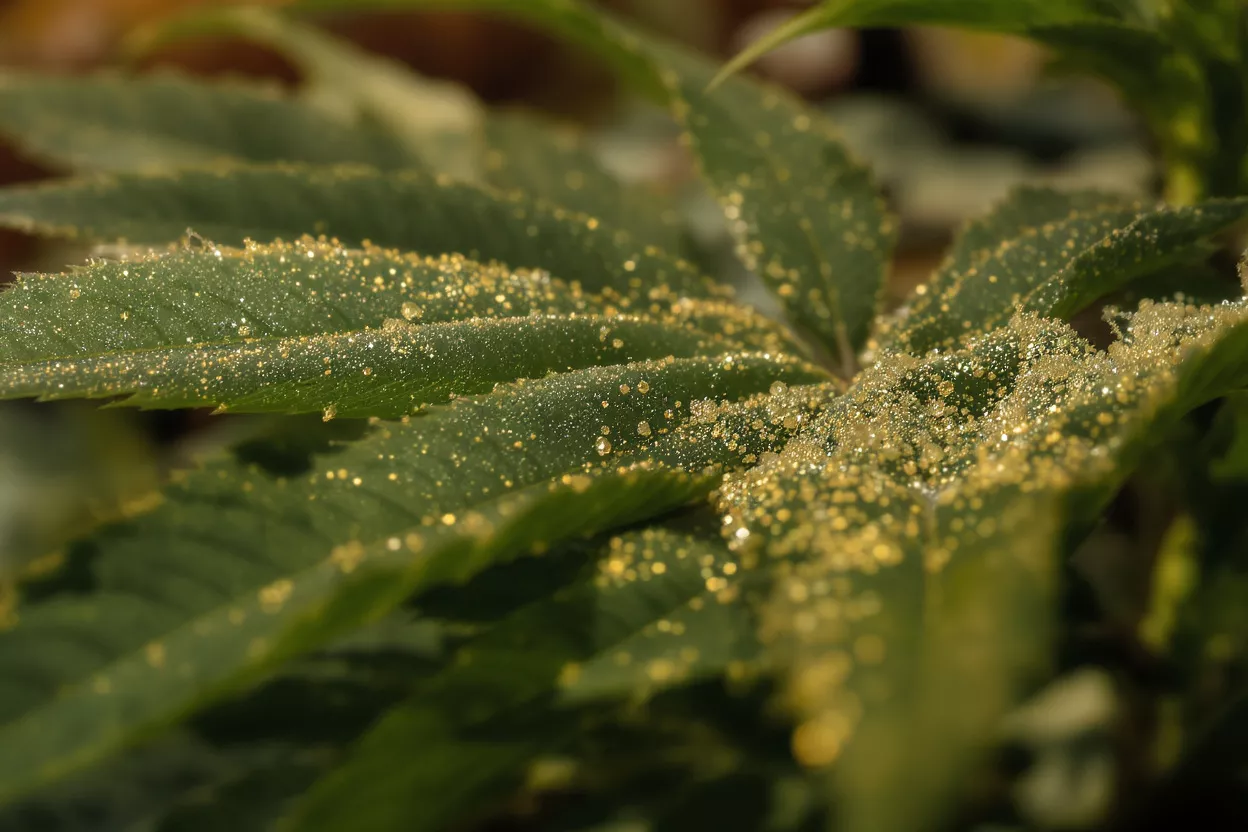
This fat-loving design has an evolutionary logic for the plant as well. Cannabinoids are produced and stored in the sticky trichomes that coat cannabis flowers, where their oily nature keeps them concentrated in resin glands rather than washing away. The very property that makes these compounds challenging to formulate is the same property that allows the plant to protect and preserve them.
How Do Lipophilic Compounds Absorb in the Body?
Absorption is where lipophilicity becomes both an advantage and an obstacle. On one hand, lipophilic molecules pass easily through cell membranes, which are themselves made of fatty lipid bilayers. A molecule that loves fat slips through these membranes with little resistance, allowing it to reach receptors inside cells. On the other hand, before a cannabinoid can cross a membrane, it usually has to travel through watery environments like saliva, stomach contents, or blood plasma, and this is where things get complicated.
The first-pass metabolism problem illustrates the challenge clearly. When a lipophilic cannabinoid is swallowed, it must dissolve in the digestive tract, get absorbed into the intestinal wall, and then pass through the liver before reaching the bloodstream. The liver aggressively metabolizes these compounds, so a large fraction never reaches circulation intact. This is one reason edibles can feel inconsistent and why their effects are delayed compared with inhalation.
Inhalation sidesteps much of this struggle. When cannabis is vaporized or smoked, cannabinoids cross the thin, fat-rich membranes of the lungs almost instantly and enter the bloodstream directly, bypassing the liver's first pass. The lipophilic nature of the molecules is a perfect match for the lung's lipid-lined alveoli, which is why inhaled effects arrive within minutes.
Lipophilic Cannabis Distribution and Storage in Fat
Once cannabinoids enter the bloodstream, their lipophilic character continues to dictate their journey. Because they are repelled by water, they do not linger in the watery plasma for long. Instead, they rapidly distribute into fatty tissues throughout the body, including adipose tissue, the brain, and other organs rich in lipids.
Why THC lingers in the body comes down to this fat storage behavior. Adipose tissue acts as a reservoir, slowly absorbing cannabinoids and then releasing them back into circulation over days or even weeks. This explains why THC metabolites can be detected in drug tests long after the psychoactive effects have faded, particularly in frequent consumers whose fat stores accumulate larger reserves.
This distribution pattern also influences the experience of cannabis itself. Because lipophilic cannabinoids readily cross the blood-brain barrier, which is built from lipid-rich membranes, they reach the central nervous system efficiently and interact with the endocannabinoid system. The same fat-loving property that complicates oral absorption is what allows cannabinoids to reach the brain and produce their characteristic effects.
Formulation Challenges With Lipophilic Cannabis Extracts
For product developers, the lipophilic nature of cannabis extracts is the central engineering puzzle. A compound that refuses to dissolve in water is difficult to incorporate into beverages, sublingual sprays, and many other water-based products that consumers want. Simply mixing cannabis oil into water produces an unstable mixture that separates almost immediately, much like trying to dissolve butter in a glass of water.
Stability and shelf life add another layer of difficulty. Lipophilic extracts can settle, clump, or stick to packaging, leading to inconsistent dosing from one serving to the next. A consumer who shakes a bottle and gets a heavy dose one day and a weak one the next is experiencing the practical consequences of poor lipophilic formulation. Achieving uniform distribution across a product requires deliberate engineering.
Several common strategies have emerged to tame these extracts:
- 🧈 Carrier oils: Dissolving cannabinoids into MCT, olive, or hemp seed oil keeps them in a compatible lipid environment and improves dosing consistency.
- 💧 Emulsification: Breaking oil into tiny droplets suspended in water creates beverages and water-soluble powders.
- 🧪 Encapsulation: Wrapping cannabinoids in protective shells shields them from degradation and controls release.
- 🌡️ Liposomal delivery: Packaging compounds inside lipid spheres mimics the body's own membranes for smoother absorption.
Lipophilic vs Hydrophilic Cannabinoids Explained
To fully appreciate what makes cannabis compounds unique, it helps to contrast lipophilic substances with their opposite: hydrophilic, or water-loving, molecules. Hydrophilic compounds carry polar or charged regions that bond easily with water, dissolving cleanly into plasma, saliva, and other aqueous fluids. Most pharmaceutical drugs are designed to be at least partly hydrophilic so they distribute predictably through the bloodstream.
The balance pharmacologists chase is a happy medium between the two extremes. A drug that is too lipophilic gets trapped in fat and absorbs erratically, while one that is too hydrophilic cannot cross fatty cell membranes to reach its target. Cannabinoids sit firmly on the lipophilic end of this spectrum, which is both their gift and their burden in delivery science.
The practical differences between these two categories become clear in a side-by-side comparison:
- 🛢️ Lipophilic: Dissolves in oils, crosses cell membranes easily, stores in fat, absorbs slowly when eaten.
- 🚰 Hydrophilic: Dissolves in water, struggles to cross membranes, clears the body faster, distributes evenly in blood.
- ⚖️ Amphiphilic: Has both properties at once, which is why emulsifiers and surfactants can bridge the two worlds.
Improving Lipophilic Cannabis Bioavailability
Bioavailability refers to the fraction of a dose that actually reaches the bloodstream in an active form. For lipophilic cannabis compounds taken orally, bioavailability is notoriously low, often estimated at just 6 to 20 percent because so much is lost to poor water solubility and first-pass metabolism. Improving this figure is one of the most active areas of cannabis product science.
Taking cannabinoids with fat is the simplest evidence-based trick. Studies have shown that consuming cannabis edibles alongside a fatty meal can substantially increase absorption, because the dietary fat helps solubilize the lipophilic cannabinoids and ushers them into the lymphatic system. This is why many edible manufacturers recommend taking products with food rather than on an empty stomach.
More sophisticated approaches engineer the molecule's environment directly. Self-emulsifying drug delivery systems, cyclodextrin complexes, and nanoparticle carriers all aim to present lipophilic cannabinoids to the body in a form it can absorb efficiently. The goal across all of these technologies is the same: deliver more of the active compound with less waste and more predictable timing.
Lipophilic Properties in Edibles and Topicals
The fat-loving nature of cannabinoids shapes two of the most popular product categories in different ways. In edibles, lipophilicity explains both the delayed onset and the often longer-lasting effects. Cannabinoids must work their way through the digestive system and fat compartments before producing noticeable results, which can take an hour or more.
Why topicals stay local is also a story about lipophilicity. When a cannabis cream or balm is applied to the skin, the lipophilic cannabinoids interact with the skin's natural lipid layers and receptors near the surface. Most do not penetrate deeply enough to reach the bloodstream in significant amounts, which is why typical topicals provide localized relief without intoxication.
Formulators exploit these tendencies deliberately. A topical intended for surface effects relies on the cannabinoid's affinity for skin lipids, while a transdermal patch is specifically engineered with permeation enhancers to push lipophilic compounds all the way through the skin and into circulation. Understanding the molecule's fat-loving behavior is what lets developers steer a product toward localized or systemic effects.
Nanoemulsion Technology for Lipophilic Cannabinoids
Among the most transformative innovations in cannabis formulation is nanoemulsion technology, which directly tackles the water-incompatibility of lipophilic compounds. A nanoemulsion breaks cannabis oil into droplets measured in nanometers, so small that they remain suspended in water and resist separating. The result is a product that behaves as if the cannabinoids were water-soluble even though they remain lipophilic at their core.
Faster onset in beverages is the headline benefit of this approach. Because the droplets are so tiny, they present an enormous surface area to the digestive tract and absorb far more readily than ordinary cannabis oil. Many water-soluble cannabis drinks built on nanoemulsions report onset times closer to inhalation than to traditional edibles, a meaningful shift for consumers who want predictable timing.
Nanoemulsions also improve dosing precision and stability. Evenly distributed nanodroplets mean each sip or serving delivers a consistent amount, and the small droplet size resists the settling that plagues coarser mixtures. This combination of better bioavailability, faster onset, and reliable dosing has made nanoemulsion a cornerstone of modern infused beverages and rapid-onset products.
Why Lipophilicity Matters for Cannabis Consumers
For the everyday consumer, lipophilicity is not just an abstract chemistry concept; it quietly governs the choices that lead to a good or frustrating experience. Knowing that cannabinoids love fat explains why an edible taken with a meal hits harder, why an oil tincture held under the tongue works differently than one swallowed, and why effects can linger longer than expected.
Making smarter product decisions becomes easier with this knowledge. If you want rapid, predictable effects, an inhaled or nanoemulsified product makes sense because it sidesteps the slow, fat-dependent absorption of conventional edibles. If you want long-lasting effects, a fat-rich edible may be ideal precisely because lipophilic cannabinoids store and release slowly from tissue.
Ultimately, the lipophilic nature of cannabis is the thread that connects the plant's biology, the science of absorption, and the design of every product on the shelf. From the resin in a trichome to the nanodroplet in a beverage, the same fat-loving chemistry is at work. Understanding it transforms cannabis from a mystery into a system you can navigate with confidence, choosing products that match how your body actually processes these remarkable compounds.