Xanthan
Learn how xanthan stabilizes cannabis edibles, tinctures & topicals.
What Is Xanthan in Cannabis Products?
Xanthan cannabis formulations depend on one of the food industry's most versatile additives to solve a problem that plagues nearly every infused product: keeping oil, water, and active compounds evenly distributed. Xanthan gum is a polysaccharide produced through the bacterial fermentation of sugars by Xanthomonas campestris, the same microorganism responsible for spots on leafy vegetables. When that fermentation broth is processed, dried, and milled into a fine powder, the result is a thickening and stabilizing agent that has become indispensable in modern edibles, beverages, and topical preparations.
In the context of infused products, xanthan does far more than make a syrup feel thick. It builds the internal structure that suspends cannabinoid-rich oil droplets, prevents settling, and delivers a consistent dose in every serving. Without a reliable suspending agent, a batch of THC-infused beverage would separate, concentrating active compounds at the top or bottom of the bottle and making accurate dosing nearly impossible.
Why formulators reach for xanthan first: It works at extremely low concentrations, typically between 0.1% and 0.5% of a finished recipe, and remains stable across a wide range of temperatures, pH levels, and salt conditions. For cannabis manufacturers juggling unpredictable extract chemistry, that resilience is precisely what makes xanthan a default choice rather than an afterthought.
How Xanthan Gum Works as a Stabilizer
The functional magic of xanthan comes from its molecular architecture. Each chain is a long backbone of glucose units decorated with side groups that twist into a rigid helical structure. When dispersed in water, these helices interact loosely, forming a weak, reversible network that gives liquids a property scientists call pseudoplasticity, or shear-thinning behavior.
Shear-thinning explained for product design: At rest, a xanthan solution behaves almost like a soft gel, trapping oil droplets and particles so they cannot rise or sink. The moment you shake, pour, or stir it, that network temporarily collapses and the liquid flows freely. Stop the motion and the structure rebuilds within seconds. This is why a cannabis beverage can pour smoothly yet hold its suspended cannabinoids in place between sips.
This dual behavior is the reason xanthan outperforms simpler thickeners. A starch slurry thickens uniformly but feels heavy and can break down under heat or acid. Xanthan holds its structure when needed and yields when force is applied, giving formulators precise control over mouthfeel, suspension, and pour without sacrificing stability.
Why Xanthan Cannabis Edibles Rely on This Ingredient
Walk through the ingredient list of most commercial gummies, baked goods, and chews, and you will frequently find xanthan working quietly in the background. In edibles, the gum performs several roles at once: it binds moisture, improves texture, prevents crystallization, and crucially helps distribute cannabinoid extract evenly throughout the batter or gel before it sets.
Dose uniformity in xanthan cannabis edibles: The single greatest challenge in edible manufacturing is making sure every piece in a batch carries the same milligram count. Because cannabis oil is hydrophobic and tends to pool, a stabilizer that holds it in even suspension during mixing and cooling directly improves dose accuracy. Xanthan thickens the unset mixture enough to lock droplets in place until the product solidifies.
Texture and shelf appeal: Beyond dosing, xanthan contributes to the chew, elasticity, and moisture retention that consumers expect. It helps gummies resist becoming sticky or grainy over time and keeps baked goods from drying out. For products that may sit on a shelf for months, that moisture management protects both texture and the consumer experience.
- 🧪 Suspension: Holds cannabinoid oil evenly distributed so each serving delivers a consistent dose.
- 💧 Moisture control: Retains water in chews and baked items to extend softness and freshness.
- 🍬 Anti-crystallization: Discourages sugar from recrystallizing, keeping gummies smooth.
- ⚖️ Low dosage: Effective at fractions of a percent, leaving flavor and texture untouched.
Xanthan in Cannabis Tinctures and Beverages
Liquid products present the toughest stability challenge in the entire category, and this is where xanthan truly earns its place. In a tincture or an infused drink, separation is not merely cosmetic, it is a dosing failure. A consumer who pours from a poorly stabilized bottle may receive a fraction of the intended dose in one serving and a concentrated overdose in the next.
Suspending nanoemulsions and oils: Many modern beverages use nanoemulsion technology to make cannabinoids water-compatible, but even these systems benefit from a low level of xanthan to prevent creaming and droplet migration over a long shelf life. The gum forms an invisible scaffold throughout the liquid that physically restrains droplets from drifting toward the surface.
Formulators must walk a fine line in beverages, however. Too much xanthan produces a slimy or ropey texture that consumers reject instantly. The target is usually well below 0.2%, just enough to provide suspension while keeping the drink thin and refreshing. Achieving that balance often requires pairing xanthan with complementary gums that round out the mouthfeel.
Xanthan Cannabis Topicals and Texture Control
Creams, lotions, balms, and gels rely on xanthan to deliver the smooth, professional texture consumers associate with quality skincare. In a cannabis topical, the gum stabilizes the emulsion that binds water and oil phases together while suspending cannabinoid extract evenly so the active compound is distributed across the skin with each application.
Emulsion stability in xanthan cannabis topicals: Lotions are inherently unstable mixtures of incompatible ingredients. Over time, untreated emulsions separate into watery and oily layers. Xanthan thickens the water phase and reinforces the interface, dramatically extending the shelf life of a product and keeping its appearance consistent from first use to last.
Xanthan also governs how a topical feels and spreads. It provides enough body that a cream holds its shape in the jar yet glides easily under the fingertips thanks to that same shear-thinning behavior seen in beverages. This controlled slip is part of why xanthan appears in everything from light serums to thick recovery balms.
Types of Xanthan Formulations in Manufacturing
Not all xanthan is identical. Suppliers offer several grades distinguished by mesh size, transparency, and dispersion behavior, and choosing the right one shapes the final product's quality. Coarse-mesh grades hydrate slowly and resist clumping, making them easier to disperse, while fine-mesh grades hydrate fast and build viscosity quickly.
Matching grade to application: A clear cannabis beverage demands a high-clarity, transparent grade so the liquid does not turn cloudy, whereas an opaque lotion can use a standard grade without concern. Manufacturers also choose between regular and rapidly hydrating versions depending on whether their process allows time for the gum to fully develop its structure.
- 🔬 Standard grade: The all-purpose workhorse for opaque edibles and topicals where clarity is irrelevant.
- ✨ Clarified grade: Refined for transparent beverages and gels where a clear appearance is essential.
- ⚡ Rapid-hydrating grade: Builds viscosity fast, ideal for continuous or high-speed production lines.
- 🌾 Coarse mesh: Disperses without clumping, favored when blending by hand or in low-shear systems.
Sourcing matters as well. Xanthan can be produced using glucose derived from corn, wheat, soy, or dairy substrates, which has implications for allergen labeling. Cannabis brands serving consumers with sensitivities must confirm the substrate origin with their supplier to make accurate claims.
Is Xanthan Safe to Consume?
Xanthan gum carries one of the strongest safety profiles of any common food additive. Regulatory agencies worldwide, including the FDA in the United States and EFSA in Europe, recognize it as safe for consumption, and it has been used in food, pharmaceuticals, and cosmetics for decades without significant safety concerns at normal usage levels.
Digestion and tolerance: The human body does not break xanthan down for energy; it passes through largely intact and behaves as a soluble fiber. In the very small quantities found in cannabis products, it has no meaningful effect on digestion for most people. Only at unusually high intakes, far beyond what any infused product would contain, might sensitive individuals notice mild bloating or a laxative effect.
The most relevant caution involves allergen sourcing rather than the gum itself. Because xanthan is fermented on a sugar substrate that may originate from wheat, corn, soy, or dairy, individuals with severe allergies should verify the source. Reputable suppliers provide documentation confirming the substrate and the absence of residual allergenic proteins.
Xanthan vs Other Gums and Thickeners
Xanthan rarely works alone. Formulators frequently combine it with other hydrocolloids to achieve effects that no single ingredient delivers. Understanding how it compares to its alternatives clarifies why it remains the backbone of so many infused recipes.
Synergy with guar and locust bean gum: Xanthan exhibits a famous synergistic relationship with locust bean gum, producing a true elastic gel that neither ingredient forms on its own. Blended with guar gum, it boosts viscosity beyond the sum of its parts. These partnerships let manufacturers fine-tune texture, from pourable syrups to sliceable gels, using minimal total gum.
Compared to gelatin, xanthan offers a vegan, plant-derived alternative that does not melt at body temperature, which matters for products meant to survive warm shipping conditions. Against starches, it resists breakdown from heat and acid, holding viscosity where a starch would thin out. Each thickener has its place, but xanthan's stability across hostile conditions explains its dominance.
- 🌱 vs Gelatin: Plant-based and heat-stable, where gelatin is animal-derived and melts when warm.
- 🔗 vs Starch: Resists acid and heat breakdown, holding viscosity that starch would lose.
- 🤝 vs Guar gum: Pairs synergistically to multiply thickness using less total ingredient.
- 🧊 vs Locust bean gum: Combines to form a genuine elastic gel neither makes alone.
Xanthan Processing and Formulation Considerations
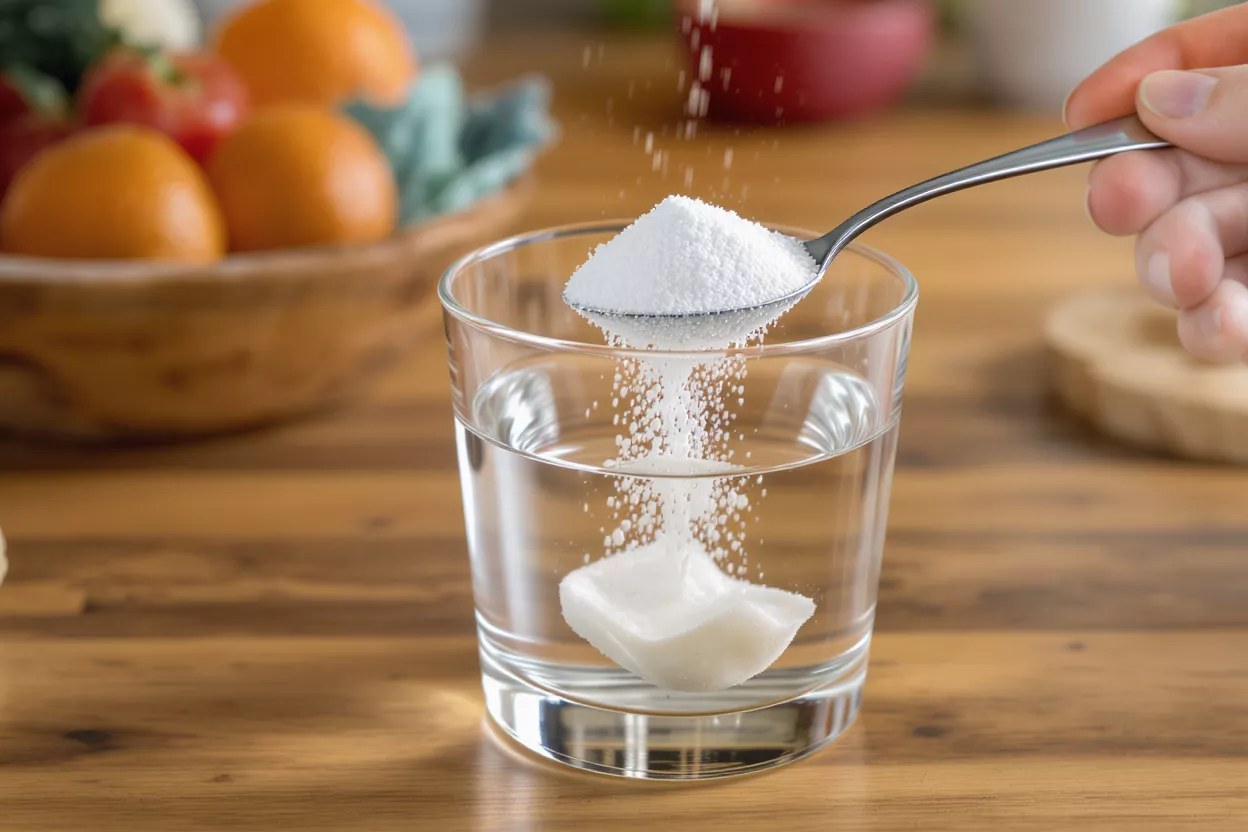
Working with xanthan demands respect for its hydration behavior. The most common manufacturing mistake is dumping the powder directly into water, which produces fisheyes, clumps of dry gum coated in a hydrated shell that never fully dissolve. Proper dispersion is the difference between a flawless batch and a ruined one.
Dispersion techniques that prevent clumping: Experienced formulators pre-blend xanthan with a dry carrier such as sugar or another powdered ingredient before introducing it to liquid, or they disperse it into a non-aqueous medium like glycerin or oil first. High-shear mixing while slowly sifting the powder also keeps particles separated long enough to hydrate individually.
Order of addition matters when cannabinoid extracts enter the picture. Many manufacturers fully hydrate the xanthan network first, then incorporate the cannabinoid emulsion or oil so the existing structure immediately captures and suspends the droplets. Temperature, pH, and salt content all influence final viscosity, so recipes must account for the complete ingredient matrix rather than the gum in isolation.
Xanthan Quality Standards and Regulatory Compliance
Because cannabis products face layered scrutiny, the xanthan that goes into them must meet rigorous quality specifications. Food-grade and pharmaceutical-grade xanthan are produced to defined standards governing purity, viscosity, particle size, microbial limits, and heavy metal content. Sourcing from a supplier who provides a certificate of analysis protects both the manufacturer and the consumer.
Specifications that matter for compliance: Key parameters include viscosity within a stated range, moisture content, ash content, and limits on residual solvents and contaminants. For cannabis brands, these specifications dovetail with the broader testing regime their finished products already undergo, ensuring the additive does not introduce contaminants that would cause a batch to fail laboratory screening.
Labeling and consumer transparency: Regulators increasingly expect clear ingredient disclosure, and xanthan must appear accurately on the label alongside any allergen statements tied to its substrate. Transparent sourcing and documentation are not just regulatory boxes to check; they build the consumer trust that distinguishes a premium cannabis brand from a careless one.
From the gummy that delivers a precise dose to the beverage that pours clear and stays suspended, xanthan is the unsung architecture behind reliable infused products. Its bacterial origin, shear-thinning behavior, and remarkable stability across heat, acid, and salt make it the default stabilizer wherever consistency matters. Understanding how this single ingredient governs texture, suspension, and dose uniformity reveals just how much careful formulation stands behind every well-made cannabis product on the shelf.