


Research on CBD for Pets 2026: What Science Says About Effectiveness
Discover what veterinary science says about CBD for pets in 2026.
If you share your home with a dog who trembles during thunderstorms or a senior cat who has slowed down on the stairs, you have probably wondered whether CBD for pets is more than a marketing trend. The category has exploded over the past several years, and with that growth has come a flood of claims, anecdotes, and genuine scientific curiosity. Sorting the evidence from the enthusiasm matters, because what you give your animal companion deserves the same scrutiny you would apply to your own wellness routine.
This guide pulls together what veterinary science actually understands about cannabidiol in animals as we head into 2026. We will look at how it interacts with the body, what controlled studies have found, where the evidence is still thin, and how to choose and dose a product responsibly. The goal is not to sell you on a miracle, but to give you a clear-eyed picture so you can have an informed conversation with your veterinarian.
What Is CBD for Pets and How Does It Work
CBD, or cannabidiol, is one of more than a hundred compounds found in the cannabis plant. Unlike THC, the molecule responsible for the intoxicating effects of marijuana, CBD does not produce a high. Pet-formulated products are typically derived from hemp, a cannabis variety bred to contain only trace amounts of THC. This distinction is the entire foundation of why CBD for pets is considered a viable wellness option rather than a risk to your animal's safety.
The way CBD influences the body is indirect and nuanced. Rather than binding tightly to a single receptor and flipping a switch, cannabidiol modulates a broad network of signaling pathways. It influences how the body processes its own naturally produced cannabinoids, interacts with serotonin receptors tied to mood, and affects receptors involved in pain and temperature perception. Some products pair CBD with calming companions like Theanine or L-tryptophan to round out the effect, and you will occasionally see formulas that lean on functional mushrooms such as Lion's Mane for cognitive support in aging animals.
Because the compound works through so many channels rather than one dominant mechanism, its effects tend to be subtle and cumulative rather than dramatic and immediate. That is an important expectation to set early: most owners who report success describe gradual shifts over days or weeks, not an overnight transformation.
The Endocannabinoid System in Animals Explained
Every mammal carries an endocannabinoid system, a regulatory network that helps keep internal processes in balance. Dogs, cats, horses, ferrets, and rabbits all have it. This system consists of receptors (primarily CB1 and CB2), the endocannabinoids the body produces on demand, and the enzymes that build and break those molecules down. Its job is homeostasis: nudging functions like sleep, appetite, immune response, mood, and pain perception back toward equilibrium when they drift.
CB1 receptors cluster heavily in the brain and nervous system, while CB2 receptors are more common in immune tissue and the periphery. Interestingly, research from Johns Hopkins Medicine and other institutions has helped clarify how cannabinoids interact with these receptors across species, which is part of why findings in human and rodent models can sometimes inform veterinary thinking. CBD does not jam itself into these receptors the way THC does; instead it appears to influence their sensitivity and the availability of the body's own cannabinoids.
Dogs, it turns out, have a notably dense population of CB1 receptors in the brain compared with humans. This is precisely why THC is so dangerous to them and why responsible pet products are formulated to be THC-free or near-zero. The same receptor density may also mean dogs are particularly responsive to cannabinoid signaling, which is one hypothesis researchers are still working to confirm.

What Does the Research on CBD for Pets Say in 2026
The honest summary is that the science is promising but still young. A handful of well-designed studies, most notably out of veterinary teaching hospitals, have produced encouraging results for specific conditions, particularly osteoarthritis pain in dogs. These trials used pharmaceutical-grade CBD, controlled dosing, and objective outcome measures, which makes their findings far more meaningful than the testimonial reviews that dominate the marketplace.
That said, the body of peer-reviewed literature remains modest. Most studies involve small sample sizes, short durations, and focus almost entirely on dogs. Cats are dramatically understudied, and species like horses and small mammals have barely been touched. The research that does exist tends to point in a positive direction for pain and certain behavioral concerns, but the field has not yet produced the large, long-term, multi-center trials that would let veterinarians prescribe with full confidence.
Here is where the evidence currently stands by category:
- 🦴 Joint and arthritis pain: Strongest evidence; multiple controlled canine trials show measurable improvement in mobility and comfort.
- 😰 Anxiety and stress: Moderate and growing; promising early data plus a large volume of consistent owner reports.
- ⚡ Seizure activity: Emerging; small studies suggest reduced frequency in some epileptic dogs when paired with standard medication.
- 🤢 Nausea and appetite: Mostly extrapolated from human and rodent research, limited direct pet data.
- 🐱 Feline applications: Largely unstudied; dosing and safety in cats need far more dedicated research.
Can CBD for Pets Help With Anxiety and Stress
Anxiety is one of the most common reasons owners reach for CBD in the first place. Separation distress, noise phobias around fireworks and storms, travel anxiety, and vet-visit panic drive a huge share of the interest in this category. The theoretical basis is sound: CBD's interaction with serotonin receptors mirrors, in a gentler way, the mechanism behind some conventional anti-anxiety approaches.
Early controlled research has begun testing CBD against situational stressors, with some studies showing reduced stress markers and calmer behavior during triggering events. The results are not uniform, and a few trials have found little effect, which is exactly what an honest emerging field looks like. For owners exploring options, a well-formulated calming CBD oil for dogs taken consistently in the lead-up to a stressful event tends to outperform a single dose given in a panic.
Consistency is the recurring theme. Because cannabidiol works cumulatively, animals with chronic, ongoing anxiety often respond better to daily maintenance dosing than to occasional rescue use. Pairing the supplement with behavioral training, environmental management, and a predictable routine produces far better outcomes than CBD alone. Think of it as one tool in a broader toolkit rather than a standalone fix.

CBD for Pets and Joint Pain or Inflammation
This is the area where the science is most convincing. Several controlled trials in dogs with osteoarthritis have documented improved mobility, reduced pain scores, and greater willingness to play and move after consistent CBD supplementation. The proposed mechanism centers on CB2 receptors in immune and joint tissue, where cannabinoid signaling appears to dampen inflammatory activity.
For aging dogs in particular, this matters enormously. Osteoarthritis is widespread in senior and large-breed animals, and the conventional anti-inflammatory drugs that manage it can strain the liver and kidneys over long-term use. CBD is being studied as a complementary option that may allow lower doses of those medications, though this should only ever be adjusted under veterinary supervision. Many owners find that a daily hip and joint CBD chew fits naturally into a senior dog's routine.
Inflammation is not limited to joints, of course. There is preliminary interest in CBD's role in skin conditions, inflammatory bowel issues, and general immune modulation, though these applications rest on much thinner evidence than the arthritis data. A topical 2025-style balm applied directly to a sore spot is another delivery route some owners explore for localized discomfort, working the compound into the skin where the trouble lives.
Types of CBD Pet Products and How to Choose
The format you choose affects how quickly and how reliably CBD reaches your pet's system. Oils and tinctures offer the most precise dosing and relatively fast absorption, especially when dropped directly into the mouth. Treats and chews trade some precision for convenience and palatability, which matters enormously for a picky cat or a suspicious dog. Topicals target a specific area, while capsules offer consistency for animals who tolerate them.
Here is a quick comparison of the common formats:
- 💧 Oils and tinctures: Best dosing control, faster onset, easy to titrate; some pets dislike the taste.
- 🍖 Treats and chews: Highly palatable and convenient; slower onset and slightly less precise dosing.
- 🧴 Topicals and balms: Ideal for localized joint or skin issues; limited systemic effect.
- 💊 Capsules: Consistent, taste-neutral dosing; require a cooperative pet to swallow.
Whatever the format, look for full-spectrum or broad-spectrum extracts that include supporting compounds, since the so-called entourage effect suggests the whole-plant profile may outperform isolated CBD. Some owners specifically seek out top shelf 2025 formulations that emphasize organically grown, sun-grown hemp and clean extraction. Be wary of products that read more like a thc vape pen or recreational item repurposed for animals; pet-grade goods should be purpose-built and clearly THC-free.

CBD for Pets Dosing Guide by Weight
Dosing is where most owners feel the least confident, and for good reason. There is no universally agreed-upon standard, so the prevailing wisdom is to start low and go slow. A common starting point used in research and clinical practice is roughly 1 to 2 milligrams of CBD per kilogram of body weight, given once or twice daily, then adjusted gradually based on how the animal responds over a week or two.
Body weight is the primary variable, but it is not the only one. A pet's metabolism, the severity of the condition, the product's concentration, and the individual's sensitivity all play a role. This is why titration matters so much: you begin conservatively, observe carefully, and increase only if needed. Keeping a simple journal of dose, timing, and observed behavior turns guesswork into a usable pattern.
A few practical principles to keep in mind when dialing in a dose:
- 📋 Start at the low end: Begin near 1 mg/kg and hold for several days before adjusting.
- ⏱️ Give it time: Cumulative effects mean a week or more may pass before you see the full picture.
- ⚖️ Adjust in small steps: Increase gradually rather than jumping to a high dose.
- 🩺 Loop in your vet: Especially if your pet takes other medications that the liver also processes.
Never use a human product or human dosing math for an animal, and never assume more is better. The dose-response relationship for CBD is not strictly linear, and overshooting tends to produce drowsiness rather than added benefit.
Is CBD for Pets Safe and Are There Side Effects
CBD has a reassuring safety profile in the studies conducted so far, but it is not entirely without effects. The most commonly reported side effects in dogs are mild and dose-dependent: drowsiness, slight changes in appetite, and occasional loose stools. In several trials, the most consistent measurable change was a temporary elevation in a liver enzyme, which underscores why veterinary oversight matters for animals on long-term use.
The biggest practical safety concern is not CBD itself but drug interactions and product quality. Cannabidiol is processed by the same liver enzyme pathway as many common medications, meaning it can alter how those drugs are metabolized. If your pet takes seizure medication, anti-inflammatories, or other long-term prescriptions, the interaction question is genuinely important and worth a direct conversation with your veterinarian before you start.
Product quality is the other half of the safety equation. The pet supplement market is loosely regulated, and independent testing has repeatedly found products that contain less CBD than the label claims, or worse, traces of THC, heavy metals, or pesticides. A reputable brand will publish a third-party certificate of analysis for every batch. Ingredients like Tocopherol (vitamin E) sometimes appear as natural preservatives, which is fine, but the certificate is what separates a trustworthy product from a gamble.

CBD for Pets: Dogs vs Cats and Other Animals
Most of what we confidently know about CBD applies to dogs, and that gap matters. Canine studies dominate the literature because dogs are easier to study, more commonly treated for arthritis, and metabolize the compound in ways that have been more thoroughly characterized. If you own a dog, you are working with the strongest available evidence base.
Cats are a different and more cautious story. Feline metabolism differs significantly, particularly in how their livers process certain compounds, and the limited research suggests cats may absorb and clear CBD differently than dogs do. Some early data even indicates cats can show higher liver enzyme changes at comparable doses. This does not mean CBD is unsafe for cats, only that dosing should be more conservative and veterinary guidance more essential. A purpose-formulated feline-specific CBD tincture is preferable to simply scaling down a dog product.
Horses, rabbits, ferrets, and other companion animals occupy the frontier of this field, with almost no controlled research to lean on. Owners of these species are essentially extrapolating, which calls for extra caution and professional input. As the category matures, expect dedicated studies to fill these gaps, but in 2026 the responsible posture for non-canine species is humility about how little is firmly established.
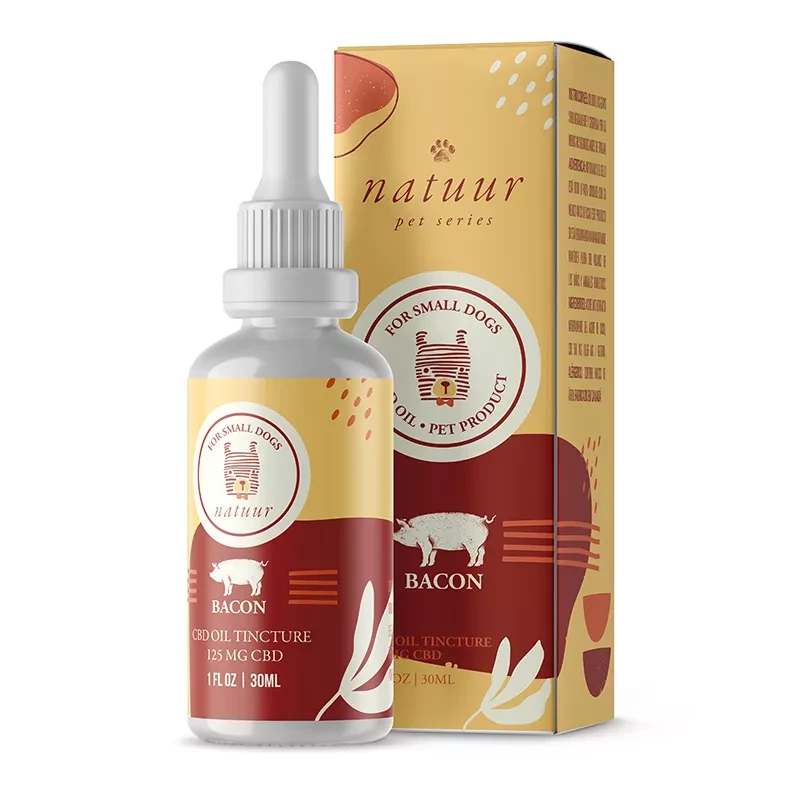

Bacon CBD Tincture for Small Dogs 125mg – Natuur
Bacon-flavoured calm, sized for the little ones. Natuur's 125mg tincture turns CBD into a treat small dogs under 25lbs look forward to, easing the worry of thunder, fireworks, and time alone while helping stiff joints stay limber. A few drops on dinner — or licked straight off the dropper — and medicine time becomes the happiest part of the routine.
- Anxiety Relief : Calms separation and noise anxiety
- Pain Management : Helps with arthritis and discomfort
- Anti-Inflammatory : Reduces joint swelling
- Seizure Support : May reduce frequency and severity
- Appetite Stimulation : Helps picky eaters
Bacon CBD Tincture for Large Dogs 750mg – Natuur
Big-dog comfort in an irresistible bacon flavour. Natuur's 750mg tincture is sized for gentle giants over 50 pounds, offering steady support for aging hips, restless nerves, and the aches of a long, active life. Drizzle it over dinner and watch the bowl disappear — calm, mobility, and mealtime joy in one easy daily ritual.
- Joint Support : Helps with hip dysplasia and arthritis
- Anxiety Management : Calms storm and separation anxiety
- Anti-Inflammatory : Reduces swelling in joints
- Pain Relief : Manages chronic discomfort
- Improved Mobility : Helps aging dogs stay active

Unflavoured CBD Pet Tincture 500mg – Natuur
Pure support, no flavour fuss. Natuur's unflavoured 500mg pet tincture gives you full control — mix it into any food or treat, dose it up or down, and skip the added flavours sensitive pets react to. Versatile and clean, it's the flexible choice for picky eaters and households that want their CBD straightforward.
- Maximum Flexibility : Mix with any food or treat
- Allergy Safe : No flavor ingredients to react to
- Pure CBD Benefits : Unmasked therapeutic effects
- Custom Dosing : Easy to adjust for any pet
- Sensitive Pet Friendly : Perfect for picky eaters
Choosing Quality CBD for Pets in 2026
With the market crowded and inconsistent, knowing how to vet a product is your most valuable skill. The single most important signal is a current, batch-specific certificate of analysis from an independent lab, confirming both the CBD content and the absence of contaminants and excess THC. If a brand will not show you that document, treat it as a red flag and move on.
Beyond lab testing, look for transparency about sourcing and extraction. Hemp grown organically, ideally sun-grown, with clean CO2 or food-grade extraction tends to yield a purer product. Clear concentration labeling in milligrams of CBD, not vague references to total oil volume, lets you dose accurately. Formulations designed specifically for animals, rather than human products with a pet label slapped on, account for species differences that genuinely matter.
Finally, set realistic expectations and stay observant. CBD is a supportive tool with real but modest evidence behind it, not a cure-all, and it works best alongside good veterinary care, proper nutrition, exercise, and behavioral support. Start low, document what you see, keep your veterinarian in the loop, and judge results by your animal's actual behavior over weeks rather than hours. Approached that way, CBD for pets can be a thoughtful addition to a well-rounded wellness plan, grounded in the growing but still-developing science we have today.




Comments