


Bioenhancer
Learn how a bioenhancer amplifies cannabinoid absorption and potency.
What Is a Bioenhancer in Cannabis?
A bioenhancer is a compound that, on its own, may have little or no therapeutic effect, yet dramatically increases the absorption and effectiveness of another active ingredient taken alongside it. In the world of cannabis, the bioenhancer concept has become central to the conversation about why some products feel stronger, last longer, or take effect faster than their milligram count would suggest. Cannabinoids like THC and CBD are notoriously difficult for the body to absorb, and a well-chosen bioenhancer can be the difference between a gummy that barely registers and one that delivers its full labeled potency.
The term originated in pharmaceutical and Ayurvedic research, where scientists noticed that certain plant compounds could multiply the bioavailability of poorly absorbed drugs. Cannabis sits squarely in that "poorly absorbed" category. Most cannabinoids are lipophilic, meaning they dissolve in fat rather than water, which creates a fundamental mismatch with the watery environment of the digestive tract and bloodstream.
Understanding bioenhancers matters because they reframe how we think about dosing. Instead of simply adding more cannabinoid to a product, formulators can add a smart bioenhancer and unlock more of what is already there. This is more efficient, often more consistent, and can reduce the amount of active material needed to reach a desired effect.
How Bioenhancer Cannabis Mechanisms Work
Bioenhancers do not all work the same way, and grouping them by mechanism is the clearest way to understand them. Broadly, they fall into three functional categories: those that improve absorption across the gut wall, those that slow the breakdown of cannabinoids by metabolic enzymes, and those that improve solubility so the cannabinoid can travel where it needs to go in the first place.
First-pass metabolism is the central obstacle. When you swallow a cannabis edible, the cannabinoids are absorbed through the intestine and routed straight to the liver before they ever reach general circulation. The liver aggressively metabolizes them, so only a fraction of the original dose survives. Bioenhancers that inhibit specific liver and gut enzymes allow more of the cannabinoid to pass through intact, raising the effective dose without changing the milligrams on the label.
Membrane permeability is the second lever. Some bioenhancers temporarily increase the fluidity of the intestinal lining, making it easier for fat-soluble cannabinoids to cross into the bloodstream. This effect is rapid and contributes to both higher peak concentrations and a quicker onset, which is why some enhanced edibles feel closer to the speed of a tincture.
Types of Natural Bioenhancer Compounds
Most bioenhancers used in cannabis are derived from food and herbs, which is part of their appeal. They carry a long history of human consumption, and many appear on grocery shelves long before they ever reach a cannabis lab. The most studied natural bioenhancers cluster into a handful of families.
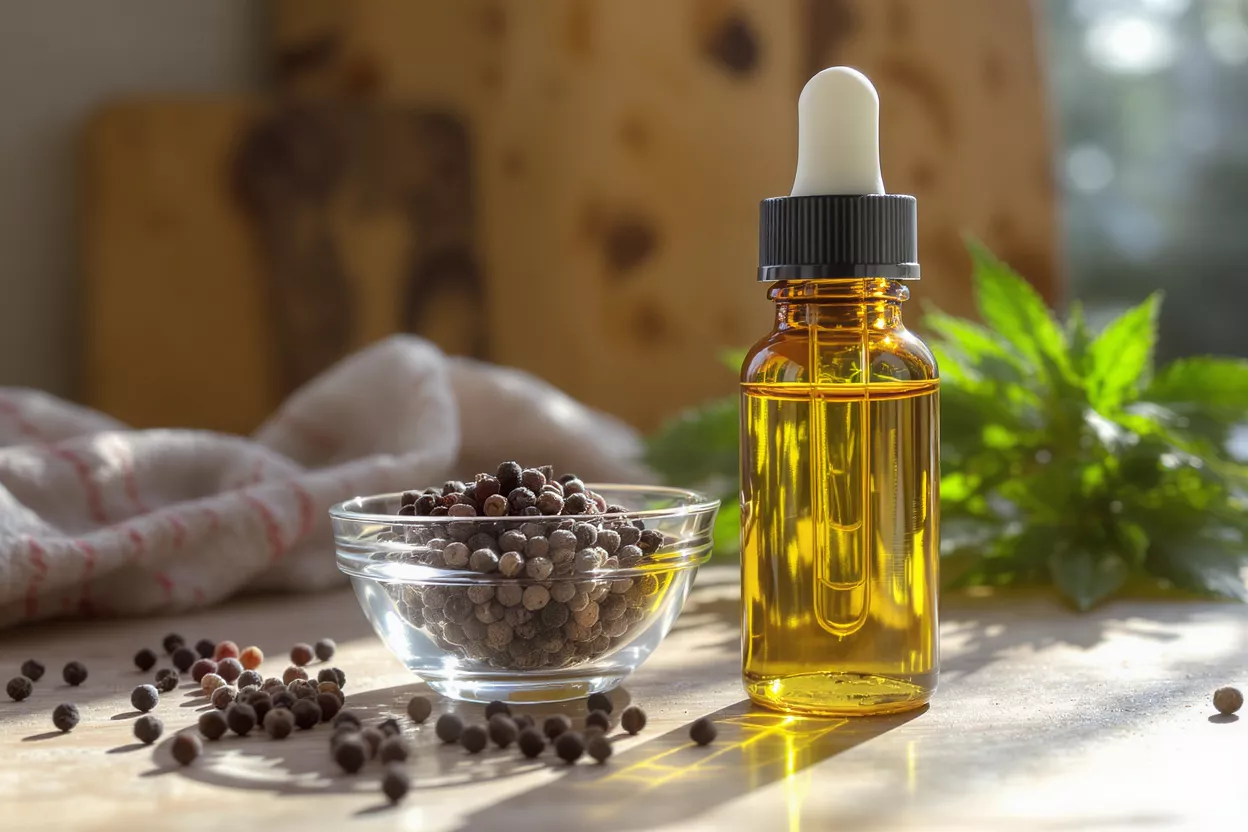
- 🌶️ Alkaloids: Piperine from black pepper is the best-known example, inhibiting drug-metabolizing enzymes and slowing intestinal transit so absorption has more time to occur.
- 🫒 Lipids: Medium-chain triglycerides and other fats act as carriers, dissolving cannabinoids and shuttling them through the lymphatic system.
- 🌿 Terpenes: Aromatic compounds in cannabis itself can improve membrane crossing and may modulate how cannabinoids interact with receptors.
- 🍵 Flavonoids: Plant polyphenols such as quercetin can inhibit the same enzymes that break cannabinoids down prematurely.
- 🧪 Glycosides and saponins: Surfactant-like molecules that improve solubility and help form stable emulsions in water-based products.
What unites these compounds is that none is a cannabinoid itself. They are supporting players, chosen for what they do to the absorption of the main active. That distinction is important when reading a product label, because a long ingredient list does not always mean a more potent product, it often means a more thoughtfully enhanced one.
The choice of bioenhancer depends heavily on the delivery format. A sublingual oil benefits from different helpers than a gummy or a capsule, and a skilled formulator matches the enhancer to the route of administration rather than reaching for the same additive every time.
Piperine: The Gold Standard Bioenhancer
Piperine, the pungent alkaloid responsible for black pepper's bite, is the most thoroughly researched bioenhancer in existence. It has been studied for decades for its ability to increase the bioavailability of everything from curcumin to pharmaceutical drugs, and that body of evidence is exactly why it appears in so many cannabis formulations.
How piperine boosts cannabinoid absorption comes down to two parallel actions. It inhibits enzymes in the gut and liver that would otherwise metabolize cannabinoids before they reach circulation, and it slows the movement of food through the intestine, giving fat-soluble compounds extra contact time with the absorptive surface. The combined effect can meaningfully raise the amount of THC or CBD that ultimately reaches the bloodstream.
Piperine is also notable for how little is required. Effective bioenhancement is typically achieved with just a few milligrams, far below the amount that would register as peppery flavor. This makes it easy to incorporate into capsules, gummies, and oils without altering the taste profile of the finished product.
Lipid-Based Bioenhancers for Cannabinoids
Because cannabinoids are fat-loving molecules, the simplest and most universal bioenhancer is fat itself. Pairing cannabinoids with the right lipids is one of the oldest tricks in cannabis preparation, and modern science has clarified exactly why it works so well.
Lymphatic transport is the key advantage. When cannabinoids dissolve in long-chain fats, a portion of the dose can be absorbed through the intestinal lymphatic system rather than the portal vein. This route partially bypasses the liver's aggressive first-pass metabolism, allowing more of the active compound to reach circulation intact. The result is a higher and often more sustained effect from the same amount of cannabinoid.
Medium-chain triglycerides, commonly sourced from coconut, are a popular carrier oil because they are easily digested, neutral in flavor, and form a stable base for tinctures and capsules. Other formulators favor long-chain fats specifically to encourage lymphatic uptake. The choice involves real trade-offs between onset speed, duration, and shelf stability.
- 🥥 MCT oil: Fast-digesting, neutral taste, ideal for tinctures and softgels where consistency matters most.
- 🫒 Long-chain fats: Encourage lymphatic absorption for a stronger, longer-lasting effect from edibles.
- 🧈 Lecithin: An emulsifier that helps cannabinoids disperse evenly and improves uptake in baked goods and gummies.
- 🌻 Sunflower and olive oils: Whole-food carriers that double as flavor bases in homemade preparations.
Terpenes as Bioenhancer Cannabis Allies
Terpenes are the aromatic compounds that give each cannabis cultivar its distinctive smell, but they are increasingly recognized for a second job: acting as bioenhancers that shape how cannabinoids are absorbed and felt. This dual role sits at the heart of what many people call the entourage effect.
The entourage effect describes the idea that cannabinoids and terpenes work better together than in isolation. Some terpenes appear to increase membrane permeability, helping cannabinoids cross into tissues more readily, while others may influence receptor activity or the experience of effects like relaxation or alertness. The science is still developing, but the practical observation that full-spectrum products often feel different from isolates is well established.
Common terpenes such as myrcene, limonene, and beta-caryophyllene each bring their own profile. Myrcene in particular is frequently cited for its potential to enhance cannabinoid uptake, which is one reason it features so prominently in discussions of sedating cultivars. Because terpenes are already native to the plant, including them is less an additive and more a matter of preserving what nature provided.
Bioenhancer Benefits for Edibles and Oils
The practical payoff of bioenhancement is most obvious in edibles and oils, where absorption is the single biggest variable separating a reliable product from a disappointing one. Unenhanced edibles can lose the majority of their cannabinoid content to first-pass metabolism, which is why effects can feel weak or frustratingly inconsistent from one batch to the next.
More predictable onset and intensity is the benefit users notice first. By improving how much cannabinoid actually reaches circulation, bioenhancers narrow the gap between the labeled dose and the experienced dose. That consistency is especially valuable for people using cannabis for wellness, where a reproducible effect matters more than chasing peak potency.
Lower effective doses follow naturally from better absorption. If a bioenhancer doubles bioavailability, a 5 mg gummy can deliver what previously required 10 mg of unenhanced product. For consumers this can mean fewer calories, less material, and often a gentler comedown, since the body is processing a smaller total load.
- ⏱️ Faster onset: Enhanced formulas often take effect sooner as permeability and solubility improve.
- 📊 Consistency: Less variation between doses and batches makes self-titration far easier.
- 💰 Efficiency: More effect per milligram stretches a product further and can lower cost per dose.
Are Bioenhancer Cannabis Formulas Safe?
For most people, the natural bioenhancers used in cannabis products are considered safe, in large part because they are familiar dietary compounds consumed in tiny quantities. Black pepper, coconut-derived fats, and plant terpenes have long histories of human consumption, and the amounts used for bioenhancement are generally far smaller than what you would get from a normal meal.
The flip side of better absorption deserves honest attention. A bioenhancer that increases how much cannabinoid reaches your bloodstream effectively increases your dose, even though the label number stays the same. This means an enhanced product can feel noticeably stronger than an unenhanced one at identical milligrams, and new users should treat it with corresponding caution.
The same enzyme inhibition that boosts cannabinoids can theoretically affect other medications processed by those pathways. Anyone taking prescription drugs, particularly those with narrow safety margins, should speak with a healthcare provider before regularly using enzyme-inhibiting bioenhancers like piperine. The interaction risk is usually modest, but it is real and worth a conversation.
Bioenhancer Dosing and Formulation Guide
Approaching enhanced products thoughtfully comes down to one guiding principle: start low and go slow, even more so than with conventional cannabis. Because a bioenhancer changes the effective potency, your usual milligram comfort zone may no longer apply, and the safest assumption is that an enhanced dose hits harder.
Reading an enhanced label takes a little practice. Manufacturers do not always specify how much their bioenhancer increases bioavailability, so when a product advertises enhanced absorption, treat the listed milligrams as a stronger version of the same number. A sensible starting point is to take roughly half of what you would normally consume and wait a full two hours before considering more.
For those formulating at home, the ratios matter. A pinch of black pepper in a cannabutter recipe, a generous fat base, and a dose of lecithin in gummies are accessible ways to improve uptake without specialized equipment. Patience during steeping and gentle heat preserve both cannabinoids and the fragile terpenes that contribute to the experience.
- 🟢 Start at half: Begin with roughly 50% of your normal dose when trying an enhanced product for the first time.
- ⏳ Wait two hours: Edible effects build slowly; give enhanced formulas full time before redosing.
- 🧾 Track results: Keep a simple log of dose and effect to find your enhanced sweet spot.
The Future of Bioenhancer Cannabis Research
Bioenhancer science in cannabis is still young, and the next decade promises rapid progress as legalization opens doors to formal research. Nanoemulsion technology, which shrinks cannabinoids into microscopic droplets for water-compatible absorption, is already blurring the line between bioenhancer and delivery system, and it represents one of the most active areas of innovation.
Personalized formulation is the frontier many researchers find most exciting. Because individuals metabolize cannabinoids differently based on genetics, diet, and microbiome, future products may pair specific bioenhancers to specific metabolic profiles, tightening the consistency that consumers value. The same insights could help clinicians dose medical cannabis with pharmaceutical-grade precision.
As the evidence base grows, expect bioenhancement to move from a marketing buzzword to a measured, standardized feature of quality cannabis products. The compounds themselves are ancient, but our understanding of how to deploy them is advancing quickly, and that combination of old ingredients and new science is exactly what makes this field so compelling.
In summary, a bioenhancer is the quiet partner that lets cannabinoids reach their full potential, improving absorption, smoothing out inconsistency, and stretching every milligram further. Whether it is piperine slowing metabolism, a fat carrier opening the lymphatic route, or a terpene easing the path across a membrane, these supporting compounds turn raw potency into real, reliable effect. Understanding how they work makes you a sharper consumer and a more confident one, capable of reading a label and knowing exactly why an enhanced product behaves the way it does.