


Octobowl
Learn how the octobowl percolator works, its 8-arm diffusion design, and why it delivers smoother hits.
What Is an Octobowl in Glass Terminology
The octobowl ranks among the most visually arresting percolators you will encounter in any glass glossary, and the name gives away its secret: eight downward-facing arms radiating from a central hub. Each arm ends in a cluster of fine slits that sit below the waterline, so a single inhale gets split into hundreds of tiny bubbles. The effect is a chamber that churns like a boiling kettle, cooling and filtering vapor far more thoroughly than any single-hole diffuser could manage.
For anyone new to glass terminology, the octobowl can feel like jargon piled on jargon, sitting alongside honeycomb discs, showerheads, and tree percs. Stripped of the intimidation, it is simply one geometry within a large family of diffusion components. The eight-arm layout is the defining trait that separates it from flat disc designs and the vertical slits found in other styles, and once you recognize the shape it becomes easy to spot.
Glassblowers have refined the octobowl across years of trial and error, and modern pieces reflect that accumulated knowledge. A thoughtfully made example balances arm length, slit count, and chamber volume so airflow stays smooth instead of choppy. According to Harvard Health, cooling inhaled vapor can blunt some of the harshness tied to hot smoke, which helps explain the enduring appeal of these intricate designs.
How Octobowl Percolators Work
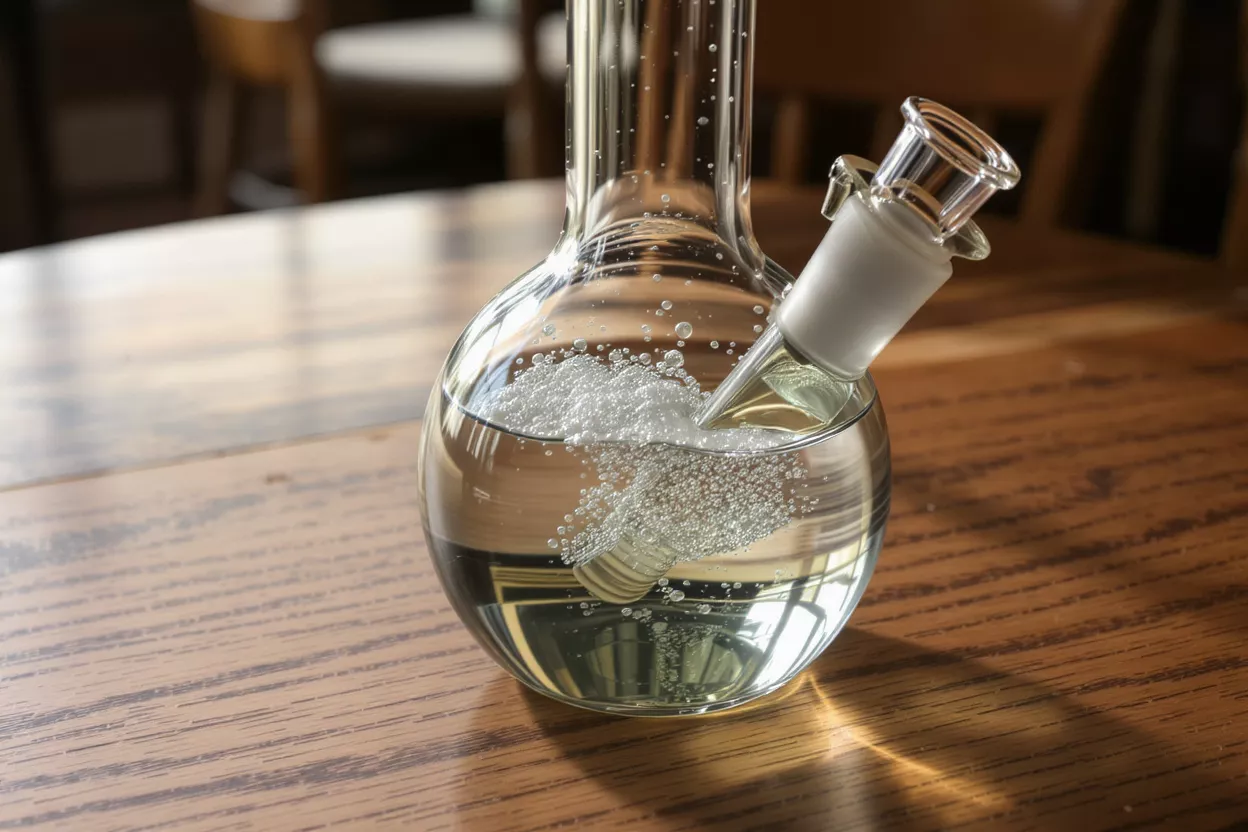
The physics of bubble diffusion sits at the heart of every octobowl. When you draw, smoke travels down a central stem and is forced outward into the eight hollow arms. Each arm terminates in a ring of small holes submerged in water, and as smoke escapes those openings it shatters into countless bubbles. That fragmentation multiplies the surface area where smoke meets water, and more contact means more heat shed and more particulate captured on a single pass.
Arm count matters because diffusion scales directly with the number of available exit points. A basic downstem might offer three or four slits, while an octobowl distributes that geometry across eight separate arms. This is precisely why the chamber appears to erupt when you pull on it. The trade-off is resistance, since more openings can add drag, but a skilled maker sizes each slit to keep the draw comfortable rather than laborious.
Why water temperature plays a role tends to surprise people who assume the glass does all the work. Cold water, and a few ice cubes when the design allows, amplifies the cooling effect by letting that dense bubble field strip away more heat before vapor reaches your lungs. Enthusiasts chasing the smoothest possible sessions often pair their rigs with quality borosilicate glass to draw the full benefit out of the octobowl's diffusion.
Octobowl vs Other Percolator Types
Setting the octobowl beside its relatives clarifies where it genuinely excels. Every percolator family balances diffusion, drag, and durability in its own way, and no single design dominates on all fronts. Understanding those differences lets you match a piece to your real preferences rather than chasing whatever stirs the most bubbles in a shop display.
Here is how the octobowl compares against the alternatives you are most likely to meet while shopping:
- 🌀 Octobowl: Eight arms deliver high diffusion with moderate drag, ideal for smokers who prioritize cooling over a wide-open draw.
- 🍯 Honeycomb disc: A flat plate riddled with holes packs excellent diffusion into a compact footprint, though it can clog more readily.
- 🌳 Tree perc: Multiple vertical arms resemble a small forest, prized for smoothness but more fragile and fiddly to clean.
- 🚿 Showerhead: A single hollow tube slitted at the base, simple to maintain with solid everyday performance.
- 🌪️ Inline: A horizontal slitted tube offering reliable filtration and easy cleaning at the cost of maximum bubble count.
Where the octobowl truly separates itself is the balance between performance and visual drama. The genetics of a strain shape its flavor, but the perc shapes how cleanly that flavor reaches you. Plenty of smokers find the octobowl lands in a sweet spot between the aggressive filtration of a honeycomb and the gentle, effortless draw of an inline.
Anatomy of an Octobowl Perc
The central diffusion hub anchors the whole structure. Smoke enters here from the downstem or a fixed stem and is distributed evenly into each of the eight arms. A well-engineered hub stops any single arm from hogging airflow, which keeps the bubble field balanced across the entire chamber instead of bubbling vigorously on one side and stalling on the other.
The arms themselves are hollow tubes angled downward so their slitted tips rest beneath the waterline. Slit count and width per arm dictate the fineness of diffusion. Tighter slits create smaller bubbles and more cooling but add resistance, while wider slits ease the draw at the expense of some filtration. Quality glass from a licensed facility tends to feature consistent slit cutting, which translates into a predictable, even pull every time.
Wrapping everything is the water chamber, sized to keep the arms submerged without flooding the mouthpiece. Chamber volume influences how far the bubbles can expand and cool before smoke continues upward. Borosilicate construction handles thermal shifts gracefully, so the piece tolerates ice and temperature swings without developing stress fractures.
Benefits of Octobowl Diffusion
Smoother, cooler hits top the list of reasons people seek out an octobowl. By breaking smoke into a dense field of tiny bubbles, the design maximizes water contact and pulls heat away efficiently. The payoff is a noticeably gentler inhale, especially valuable for anyone whose throat reacts harshly to hot, undiffused smoke. Research summarized by Harvard Health notes that the temperature of inhaled material affects perceived irritation, lending logic to the cooling-first philosophy.
Filtration is the second major draw. As bubbles travel through water, a portion of particulate matter and water-soluble compounds gets left behind. Water is hydrophilic, so it readily captures certain dissolved components rather than passing them along. No percolator removes everything, but the octobowl's high bubble count means more opportunities for that exchange to happen on each pull.
Beyond pure function, there is genuine sensory pleasure in watching an octobowl work. The cascading bubbles lend a tactile, almost meditative quality to a session, turning a quick smoke into a small ritual. Pairing the piece with a clean, precision-cut downstem keeps that diffusion consistent session after session.
How to Choose an Octobowl Piece
Selecting the right octobowl starts with an honest look at how you actually smoke. Daily users may put easy cleaning and durability first, while occasional enthusiasts might lean toward the most dramatic diffusion they can find. Neither instinct is wrong, but knowing your priorities narrows an otherwise overwhelming field of options into a short, manageable list.
Weigh these factors before committing to a particular octobowl piece:
- 💧 Joint size and fit: Confirm the perc matches your rig's joint dimensions so it seats properly without leaks.
- 🔍 Slit precision: Look for evenly cut slits, a hallmark of careful craftsmanship and consistent diffusion.
- 🧊 Chamber capacity: Larger chambers tolerate ice and leave more room for bubbles to cool the smoke.
- 🛠️ Glass thickness: Thicker borosilicate resists cracks and absorbs thermal stress from cold water and ice.
- 🧽 Cleaning access: Removable components make maintenance dramatically easier over the life of the piece.
Budget naturally enters the conversation, but treat extremely cheap glass with caution. Thin walls and sloppy slit cutting usually signal corners cut elsewhere too. A mid-range piece from a reputable maker frequently outperforms and outlasts bargain alternatives, and many shoppers find a sturdy beaker-base water pipe fitted with an octobowl perc delivers the best long-term value for the money.

How to Clean an Octobowl Perc
Why regular cleaning matters reaches well beyond appearance. Resin building up inside the eight arms narrows the slits, choking diffusion and changing the feel of the draw. Left long enough, residue harbors odors and dulls flavor. A clean octobowl performs the way its maker intended, with smooth airflow and that signature dense bubble field intact on every pull.
The classic cleaning method relies on isopropyl alcohol and coarse salt acting as an abrasive. Pour the solution into the chamber, cap the openings, and shake gently so the salt scrubs the interior arms. The intricate geometry that makes the octobowl effective also makes it harder to clean than a simple inline, so a little patience pays off. Some people finish with a splash of dish soap, though plain water usually suffices after the alcohol soak.
Frequency depends entirely on usage. Heavy daily smokers might rinse after a few sessions and run a deep clean weekly, while lighter users can stretch the intervals comfortably. Changing the water regularly slows buildup considerably, since stagnant water accelerates residue accumulation. Treat your glass like any precision tool and it will reward you with years of consistent performance.
Octobowl Glass Quality and Craftsmanship
Borosilicate is the gold standard for serious glass, and octobowls are no exception. The material withstands rapid temperature changes far better than cheaper soda-lime alternatives, which matters the moment you introduce ice or cold water. That thermal resilience means fewer stress cracks and a longer service life, easily justifying the modest price premium over flimsier options.
Craftsmanship reveals itself in the small details. Even slit spacing, smooth joint connections, and clean welds between the arms and hub all signal a maker who took their time. According to Harvard Health, the broader interest in cleaner inhalation methods has pushed manufacturers toward higher standards, and the precision of a good octobowl reflects that demand. Sloppy work shows up as uneven bubbling or arms that clog prematurely.
Hand-blown pieces from skilled artisans often command higher prices, and the artistry is real rather than marketing. Much like the gap between mass-produced and small-batch anything, a carefully crafted octobowl carries a subtle quality you can feel in the draw. Whether you favor functional simplicity or artistic flourish, the underlying glass quality should never be an afterthought.
Common Octobowl Questions Answered
Does an octobowl produce too much drag? This is the single most common worry among shoppers eyeing high-diffusion percs. The honest answer is that drag depends on slit sizing rather than arm count alone. A well-designed octobowl with appropriately sized slits draws comfortably, while a poorly cut perc of any style feels restrictive. Try before you buy when possible, or seek out reviews that focus specifically on draw feel.
People also ask whether octobowls are fragile. The eight arms do create more potential break points than a plain downstem, but quality borosilicate construction offsets much of that risk. Treating the piece with reasonable care, avoiding hard impacts and extreme thermal shock, keeps it intact for years. The arms also tuck within the chamber, offering some protection compared to fully exposed tree perc designs.
Another frequent question concerns flavor. Water filtration can soften harsh notes, but a clean piece preserves the character of your material remarkably well. Stale water or resin buildup will muddy the taste, so maintenance proves essential once again. Keep things clean and the strain's natural profile comes through clearly on every single pull.
Is an Octobowl Worth It
After weighing the design, performance, and upkeep, the octobowl earns its place for anyone who values smooth, cool hits and enjoys a touch of visual theater in their glass. The eight-arm geometry delivers genuine diffusion benefits, splitting smoke into a fine bubble field that cools and filters more thoroughly than basic alternatives. That performance asks for slightly more cleaning effort, a fair trade for most enthusiasts.
The decision ultimately hinges on your priorities. If you crave the absolute lowest drag, a simple showerhead may suit you better. If maximum diffusion drama appeals and occasional deep cleaning does not deter you, the octobowl rewards that commitment handsomely. For the broad middle seeking a balance of cooling, filtration, and reliability, it stands out clearly within the percolator landscape.
Choosing quality glass, matching the perc to your rig, and committing to regular maintenance will let any octobowl shine for years. It represents the kind of thoughtful engineering that lifts a session from merely functional to genuinely pleasurable, and that lasting value is exactly why the design continues to hold its place among the most respected percolator styles available today.



Comments